A digital piano should not become unrepairable because of one small strip of molded rubber. Unfortunately, that has been the situation for owners and technicians working on several older Roland HP and KR digital pianos. The original Roland 22185249 contact strip was discontinued years ago, while the instruments that use it have continued to develop silent, intermittent, uneven, or unexpectedly loud notes.
I have now worked with a manufacturer to put this unusual 12-note contact strip back into production. The result is a newly molded replacement based on original Roland samples, rather than a used strip removed from another aging piano or a piece of old stock that has already spent decades deteriorating.
What is Roland part 22185249?
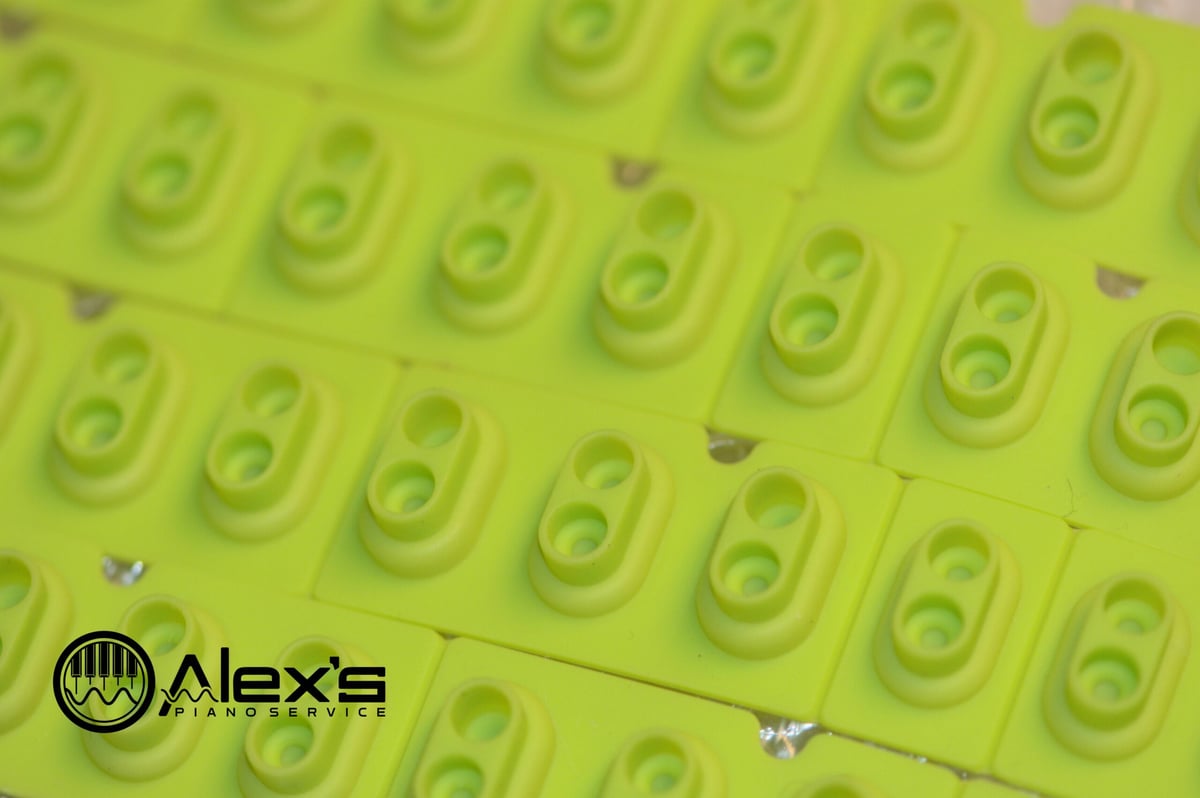
Roland part 22185249 is a molded 12-note rubber key-contact strip. Roland service documentation describes it as a Rubber Switch 12P. It sits beneath the keys and above the contact circuit board inside the keyboard assembly.
When a key is pressed, molded rubber domes collapse and bring conductive contacts against the circuit board. That is how the instrument produces a soft note from a gentle keypress and a louder note from a faster one. See my page on common digital piano troubleshooting for more information.
A contact strip may therefore be responsible for several familiar digital-piano symptoms:
- A note that does not sound
- A note that works only intermittently
- A key that plays much louder than its neighbors
- Uneven or unpredictable velocity response
- A group of problems spanning part of one octave
Contamination on the contacts can sometimes be cleaned. Once the molded rubber has deformed, hardened, torn, or lost its proper response, however, replacement is generally a better repair. And because the keyboards that use these were produced 30 years ago or longer, these contacts are generally quite worn.
Why I decided to manufacture a replacement
I began looking seriously at reproducing this part after encountering customers whose Roland pianos were still useful, attractive instruments but could not be repaired properly because the required contact strips were unavailable.
This is a particularly frustrating kind of obsolescence, and is common in my line of work as a piano and digital keyboard technician. A large digital piano may contain a substantial wooden cabinet, a weighted keyboard mechanism, speakers, amplifiers, pedals, and functioning electronics. Yet one deteriorated rubber component can make important notes unreliable and leave the entire instrument difficult to use.
Salvaged strips are not an especially satisfying answer. A used strip taken from another piano is likely to be approximately the same age as the failed part. Even unused old stock continues to age while sitting on a shelf. I wanted a genuinely new part made from freshly molded material.
The goal was not merely to find something that could be made to fit. It was to reproduce the shape, movement, alignment, and electrical behavior required by the original keyboard.
What went into manufacturing the new contact strips
At first glance, a keyboard contact strip appears simple. It is a flexible piece of molded material with a row of graphite contacts. Reproducing this particular strip accurately required considerably more work than copying its outside dimensions.
Starting with several original samples
I supplied the manufacturer with multiple original examples, including known-good strips and used or defective examples. Having more than one sample was important because a single old strip may already be compressed, stretched, distorted, or worn.
The original samples provided the basis for comparing the strip’s overall dimensions, mounting features, contact spacing, molded separation lines, rubber firmness and rebound, and the position of the conductive contact surfaces.
Creating dedicated tooling
A custom mold had to be produced for the replacement. This is one reason that small discontinued parts often remain unavailable: Manufacturing a fresh component requires tooling and prototype work before the first useful production part exists.
The full strip covers 12 notes, but the original design also includes molded lines that allow it to be separated into the shorter end sections required by some keyboard layouts. Those details had to be preserved so that one newly manufactured strip could serve the same configurations as the original.
Solving the unusual black-key geometry
The most difficult feature was underneath the five sharp-key positions. The original Roland strip has distinctive raised, rounded relief areas at those locations. Their height, shape, and flexibility affect how the rubber sits beneath the black keys and how it moves when those keys are played.
An early prototype demonstrated why this detail mattered. Most of its contacts operated electrically, but the geometry beneath the black keys was not quite right. The raised areas could produce an unwanted clicking or popping sensation. One contact also showed an inconsistent velocity reading.
That prototype was not accepted for production. The black-key relief and contact behavior required further revision. Testing the samples in an actual compatible piano, rather than simply checking their measurements on a workbench, made it possible to identify those problems before the full production run.
Making the replacement easy to identify
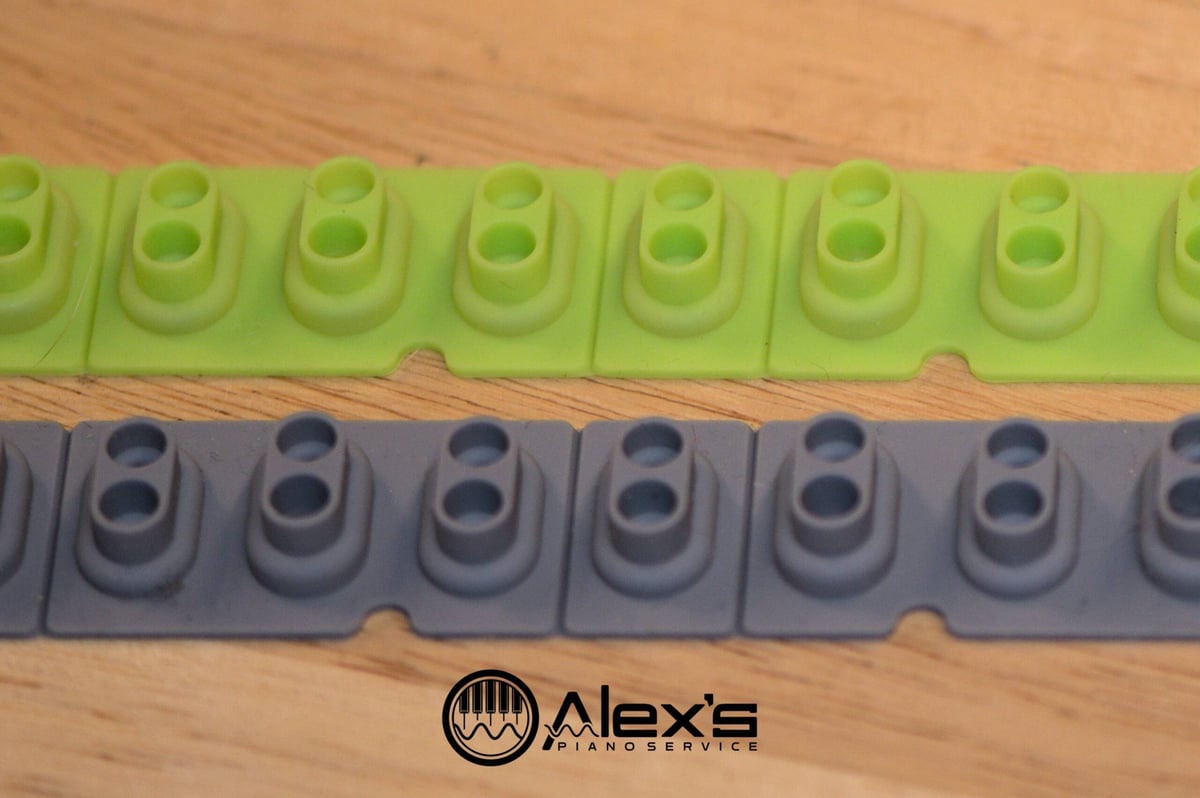
The finished replacement is molded in a distinctive lime-green material. The color does not change its operation, and isn’t visible from above or by the player, but it clearly distinguishes the newly manufactured part from the original gray strips and from old parts that may already have been moved around inside an instrument.
Each item is one complete 12-note strip. It includes the original-style molded cut lines for the shorter end configurations, but it should be separated only where required by the keyboard’s existing layout.
Compatible Roland HP and KR digital pianos
The replacement is intended for Roland digital pianos that originally used service part 22185249 and the corresponding compatible keyboard assembly.
| Series | Compatible models |
|---|---|
| Roland HP Series | HP-230, HP-900, HP-1500, HP-1700, HP-1700L, HP-1800, HP-1900G, HP-2900G |
| Roland KR Series | KR-3500, KR-4500, KR-4700, KR-5000, KR-5500 |
Important fitment note: The model number is a useful starting point, but the original strip and keyboard assembly should still be inspected before ordering. Roland used several contact-strip and keyboard designs in instruments that can look similar from the outside. A piano that has previously received a replacement keyboard assembly may no longer contain the parts originally associated with its model number.
Do not confuse Roland 22185249 with Roland 22185247. The latter is associated with a different PA-4 or PA-4A keyboard design and is not interchangeable with this strip.
How many contact strips does a piano require?
One item covers 12 notes. A complete keyboard uses several full strips and may use shorter four-note or eight-note sections at its ends, depending on the model and number of keys.
It is not always necessary to replace every strip in the piano. When a problem is limited to one note or one part of the keyboard, replacing the affected strip may be sufficient. When failures are spread across the keyboard, the technician should inspect all of the contacts and circuit boards before deciding whether a complete set is justified.
The molded separation lines make it possible to create the corresponding shorter end sections from a full strip. Cutting should follow the original configuration exactly. It is much better to compare against the strip being removed than to guess from the keyboard’s note count.
Installation is a technician-level repair
Replacing a contact strip generally requires substantial disassembly. The cabinet must be opened, the keyboard assembly accessed, and portions of the keybed removed before the contact boards and rubber strips can be reached.
The contact circuit board should also be inspected during the repair. Corrosion, debris, damaged traces, loose cables, and mechanical problems can imitate the symptoms of a defective contact strip. Installing new rubber contacts will not correct damage elsewhere in the instrument.
Owners considering this repair may find my digital piano troubleshooting guide helpful. For most people, however, installation is best handled by an experienced digital-piano or electronic-keyboard technician.
Frequently asked questions
Is this an original Roland part?
No. This is an independently manufactured replacement for discontinued Roland service part 22185249. It is not produced, sponsored, or endorsed by Roland Corporation.
Is this old stock?
No. These are newly molded contact strips, not used parts and not decades-old new-old stock.
Does one strip cover the entire keyboard?
No. One strip covers 12 notes. Several strips are used across a complete keyboard, with shorter sections sometimes used at the ends.
Will a new strip fix every silent or loud key?
No. Contact-strip failure is common, but damaged contact circuit boards, contamination, cable faults, corrosion, and mechanical problems can cause similar symptoms. The instrument should be diagnosed before parts are ordered.
Can the strip be cut into shorter sections?
Yes. It reproduces the molded separation pattern used for the corresponding shorter end configurations. It should be cut only at the designated lines and only after confirming the original layout.
Keeping repairable Roland pianos in service
Older digital pianos occupy an unusual place in the repair world. They are electronic products, but many were also built as substantial pieces of furniture with durable weighted actions and sound systems. Throwing one away because a small molded component is no longer supplied has always seemed wasteful.
Manufacturing the Roland 22185249 replacement contact strip required original samples, custom tooling, prototype testing, and a revision to get the unusual sharp-key geometry right. It was more work than simply locating an approximate rubber strip, but an approximate part was not the point.
The goal was to make a fresh, dependable replacement that gives technicians a proper repair option and allows more Roland HP and KR digital pianos to remain useful.
Roland is a trademark of Roland Corporation. This independently manufactured replacement part is not a genuine Roland product, and no affiliation, sponsorship, or endorsement is implied.