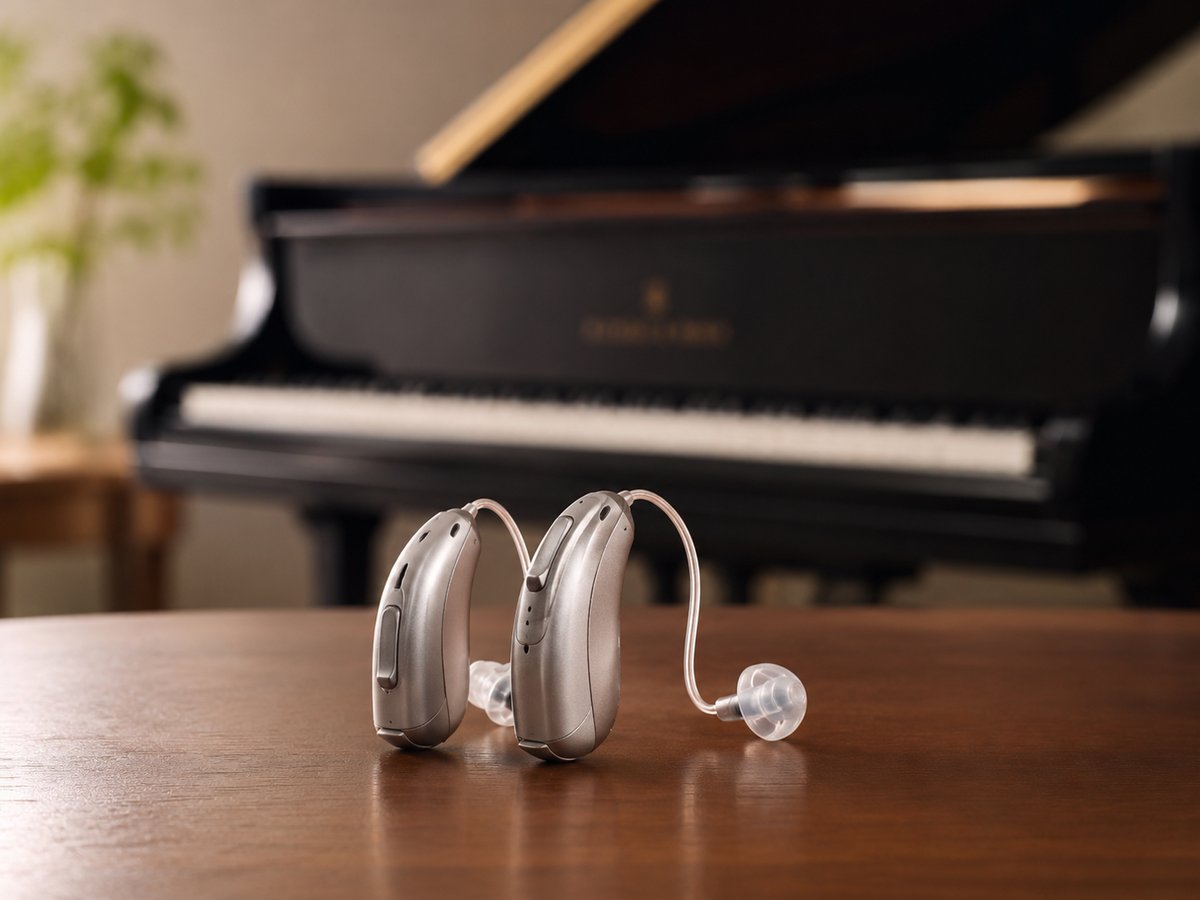
If your piano sounds sharp, flat, tinny, metallic, honky-tonk, or simply “wrong” while you are wearing hearing aids, the piano may not be the problem. Hearing aids can change the balance of piano harmonics, especially in the upper-middle range of the keyboard.
Before replacing a digital piano or assuming an acoustic piano is badly out of tune, compare hearing-aid programs, try headphones or a direct recording, and ask your audiologist about a dedicated piano or music program.
If you’re a technician, don’t dismiss the customer’s complaint just because you can’t hear it the issue yourself. There often is an explanation.
I have had several versions of this conversation with customers over the years. The customer is often a thoughtful, experienced player who knows something is wrong, but the problem is hard to demonstrate to anyone else. Sometimes the piano sounds fine to another listener, or the unpleasant sound happens on more than one instrument. Sometimes it starts around the octave above middle C, where the note itself is not extremely high, but the piano tone contains many higher harmonics. In some cases, customers believe the top octave of the piano is silent.
That can be deeply frustrating, and it can also be easy to chase the wrong problem. I’ve made several service calls over the years to customers who have been told by multiple technicians that “nothing is wrong with their piano,” and are starting to feel like they’re going crazy.
I am a piano technician, not an audiologist, so this is not medical advice. But from the piano side of the problem, there is a very real possibility worth checking. Your hearing aids may be changing the piano sound enough that certain notes seem out of tune, sharp, flat, warped, or unpleasant.
The Short Answer
Yes, hearing aids can make a piano sound out of tune even when the piano itself is in tune. This can happen with acoustic pianos, digital pianos, hybrid pianos, keyboards, and player pianos.
The most useful next step is usually to work with an audiologist on a dedicated music or piano hearing-aid program, then test the exact notes or octave range that bother you.
- If the problem happens only on one acoustic piano, the piano may simply need tuning or voicing.
- If the problem happens on only one digital piano, there could be a speaker, setting, effect, or electronics issue.
- If the same problem happens in the same register on multiple instruments, especially if other people do not hear it, hearing-aid processing becomes a strong possibility.
An Example From a Recent Customer Call
A customer recently called because the pitch and tone seemed to go wrong starting around the octave above middle C. They were frustrated because the same kind of problem seemed to happen on two different digital pianos: a higher-end Kawai and a newer Casio. They were using the built-in speakers only, with no external amplifier, Bluetooth connection, or other audio equipment involved.
Over the phone, I could not reliably hear the problem. That is not unusual. Phone microphones, speakerphone processing, room acoustics, and cellular audio compression are all terrible ways to evaluate piano tone.
I eventually asked the customer if she wore hearing aids, having encountered this problem before. She answered that she did. Then she paused, gasped, and said she couldn’t believe nobody else had mentioned this possibility.
It was unlikely that two unrelated digital pianos had developed the same pitch defect in the same part of the keyboard. A digital piano can certainly have problems, and speakers can distort at certain frequencies, but random individual notes “going out of tune” is not the most common digital-piano failure mode. A hearing-aid profile that emphasizes or suppresses certain parts of the piano sound was a more likely explanation.
The customer felt relieved, because the issue was finally being taken seriously. A sound problem that other people cannot hear can still be completely real, and it can be very frustrating because nobody else hears it!
Why Hearing Aids Can Change Piano Pitch and Tone
A piano note is not just one simple frequency. It includes a fundamental pitch plus a stack of overtones and harmonics. On an acoustic piano, those partials are not perfectly simple multiples of the fundamental because piano strings have stiffness and inharmonicity. On a digital piano, the sampled or modeled sound still contains a complex harmonic structure, since they’re typically just playing back recordings of acoustic instruments.
Your brain uses all of that information to decide what note you are hearing and what the tone color is. If a hearing aid changes the balance of those harmonics, the note can seem to change character. It may sound too bright, too thin, metallic, nasal, warbly, sour, sharp, flat, or out of tune.
This is especially noticeable on piano because the instrument has a wide frequency range, strong transients, long decays, and complex harmonics. A hearing-aid setting that works beautifully for speech in a restaurant may not work well for a piano in a quiet room.
The Hearing-Aid Features That Can Affect Piano Sound
Modern hearing aids are sophisticated. That is good, but it also means they are constantly making decisions about the sound around you. For speech, those decisions can be very helpful. For music, they can sometimes create unexpected side effects.
| Hearing-aid feature | Why it helps speech | How it can affect piano |
|---|---|---|
| Noise reduction | Reduces steady background noise | May treat parts of a sustained piano tone as unwanted sound |
| Feedback cancellation | Prevents squealing or whistling | May mistake musical harmonics for feedback and create strange tones or instability |
| Frequency lowering, shifting, or compression | Moves high-frequency speech cues into a more audible range | Can change the harmonic structure of music and make notes sound wrong or out of tune |
| Dynamic compression | Makes soft speech audible and loud sounds comfortable | Can reduce musical dynamics or make piano attacks and decays sound unnatural |
| Directional microphones | Focus on speech in front of you | May make the instrument sound less natural in a room |
| Automatic environmental programs | Switch settings based on the listening environment | May keep changing the piano sound while you play |
None of this means hearing aids are “bad.” It means that music and speech are different problems. A program designed for conversation is not always the right program for piano.
Why the Octave Above Middle C Can Be So Noticeable
Many customers describe the problem as starting somewhere around the octave above middle C. That does not mean every hearing-aid issue will happen there, but the complaint makes sense.
The note C above middle C is only around 523 Hz, but the sound of that note includes harmonics at much higher frequencies. Those upper harmonics contribute brightness, clarity, and pitch identity. Many hearing-aid adjustments also involve the upper-mid and high-frequency range, because that is where a lot of speech clarity lives. When those harmonics are over-amplified, under-amplified, shifted, or processed too aggressively, the piano tone can seem to go wrong even though the actual note being produced is correct.
How to Tell Whether It Is the Piano or the Hearing Aids
These checks are not perfect, but they can help separate an instrument problem from a listening/perception problem.
1. Change hearing-aid programs while sustaining the problem note
Play and hold the note or chord that bothers you, then switch between your normal program, music program, restaurant program, speech-in-noise program, or any custom profiles your hearing aids already have. If the “out of tune” quality changes when the hearing-aid program changes, the instrument is probably not the whole problem.
2. Try the same passage with hearing aids out, if that is safe and comfortable
Not everyone can do this usefully. If you can compare with and without the hearing aids, even briefly, it may reveal whether the strange sound is being introduced by hearing-aid processing. Do this at a comfortable volume and do not expose yourself to loud sound.
3. Ask another musician or listener
Have someone else listen in the room. Do not lead them too much. Instead of saying, “Does this sound sharp?” try asking, “Do any notes in this area sound strange to you?”
If multiple listeners hear the same defect, the instrument or room may be involved. If nobody else hears it, the problem is still real, but it may be happening in the hearing-aid/listening chain.
Be cautious of both people who are overly dismissive, and people who will hear unrelated sounds. It turns out, there’s a lot of potential ways to interpret the sound of a piano, and it’s possible to go down rabbit holes hearing different things.
4. On a digital piano, try good wired headphones
Use wired headphones if possible, not Bluetooth. Bluetooth adds another layer of processing and delay. If the piano sounds different through headphones than through the built-in speakers, the speakers, cabinet, room, or hearing aids may be interacting with the sound.
If the same notes sound wrong through both the speakers and headphones, try the next step.
5. Make a direct recording from the digital piano
If your digital piano has USB audio, line out, or a headphone output, record the sound directly and listen back on a different system. A direct recording helps separate the piano’s actual audio output from the room, built-in speakers, and hearing-aid microphone input.
If the direct recording sounds clean to other listeners, the piano sample itself is probably not defective.
6. Turn off effects and layers
On a digital piano, turn off reverb, chorus, brilliance, layering, dual voice, split voice, simulated string resonance, and any “concert hall” effects. These effects can sometimes create beating, shimmer, or phasey sounds that resemble tuning problems.
Also check that transpose, master tuning, stretch tuning, and temperament settings have not been changed accidentally.
What to Ask Your Audiologist For
The most useful request is simple:
“I play piano, and certain notes sound sharp, flat, metallic, or wrong through my hearing aids. Can we create a dedicated piano or music program and test it using the exact octave range that bothers me?”
Then ask whether the following can be adjusted in a dedicated music program, if appropriate for your hearing loss:
- Reduce or disable aggressive noise reduction for the music program.
- Reduce or disable feedback suppression if it is affecting musical tones.
- Reduce or disable frequency lowering, frequency shifting, or frequency compression for music.
- Use less aggressive compression so piano dynamics are not flattened or distorted.
- Use omnidirectional microphones instead of a speech-focused directional mode.
- Adjust gain/EQ in the specific range where the piano sounds wrong.
- Test with actual piano music, not only speech sounds or beeps.
Your audiologist should make the final decision about what is appropriate. Some features exist for important reasons, and the right setting depends on your hearing loss, hearing-aid model, earmold or dome style, feedback risk, and listening needs.
Bring the Piano Problem Into the Audiologist’s Office
Do not just tell the audiologist, “Music sounds bad.” That is too broad. Give them the exact problem.
- Bring a short recording of the problem notes. You can even use your phone to make a recording of your own piano. However, a
- Write down the exact notes or octave range that bother you.
- Test single notes, octaves, chords, and a short musical phrase.
- Compare the normal speech program with the new music program while listening to the same passage.
- Ask whether the program can be saved under a clear name like “Piano” or “Music.”
The goal is not necessarily to make the hearing aids perfect. The goal is to make the piano sound natural enough that you can play, teach, accompany, practice, and enjoy the instrument again.
When It Really Is the Piano
Hearing aids are not the explanation for every strange piano sound. The instrument should still be checked if the evidence points that way.
- Other listeners clearly hear the same out-of-tune note.
- The problem is captured in a direct recording from a digital piano.
- The sound is a buzz, rattle, crackle, distortion, or speaker vibration.
- One note is much louder or softer than the others.
- One key triggers the wrong note or multiple notes.
- An acoustic piano has not been tuned recently.
- The acoustic piano has false beats, loose tuning pins, string issues, or voicing problems.
- The digital piano has unusual effects, transpose, tuning, temperament, or layer settings enabled.
If you are in Maine and need help ruling out a piano or digital-keyboard problem, see my Digital Piano Repair FAQ, my Piano Tuning FAQ, or contact me here.
Further Reading
These resources are useful starting points for discussing music listening with an audiologist:
- American Academy of Audiology: Music Quality in Hearing Aids
- University of Iowa: Hearing Aid and Music Limitations
- University of Iowa: Hearing Aid and Music Problem-Solving Strategies
- Marshall Chasin, AuD: Optimizing Hearing Aid Processing for Music
FAQ: Pianos, Digital Keyboards, and Hearing Aids
But my hearing aids were very expensive! Could they still be the problem?
Expensive hearing aids are designed to filter sounds selectively. They’re designed to allow you to follow a conversation in a crowded restaurant, for instance. This exact selectivity can make piano sound worse. You can usually adjust these hearing aids to sound great with your piano.
Can hearing aids make a piano sound out of tune?
Yes. Hearing aids can change the balance of piano harmonics, apply compression, reduce feedback, lower frequencies, or automatically change programs. Any of those can make a piano sound sharp, flat, sour, metallic, or unnatural even when the piano itself is producing the correct pitch.
Why does my digital piano sound out of tune only on some notes?
There are several possibilities. The digital piano could have an effect setting, speaker issue, cabinet resonance, bad sample, or electronics problem. But if the same notes sound wrong on more than one keyboard, or if the problem changes when you change hearing-aid programs, the hearing aids may be affecting your perception of the tone.
Should I ask my audiologist for a music program?
Yes, especially if you play piano, sing, teach music, accompany singers, or listen critically to music. Ask for a dedicated music or piano program, separate from your everyday speech program. Bring recordings or the instrument if possible so the audiologist can adjust the hearing aids while you test the exact notes that bother you.
What hearing-aid settings affect piano sound?
Common culprits include noise reduction, feedback cancellation, frequency lowering, frequency shifting, frequency compression, directional microphones, and aggressive dynamic compression. These may be very useful for speech, but they can interfere with piano tone and pitch perception.
Can an acoustic piano still be out of tune?
Absolutely. Acoustic pianos go out of tune with humidity changes, seasonal movement, loose pins, string issues, and normal use. If other listeners hear the same tuning problem, or if the piano has not been tuned recently, schedule a tuning. Hearing aids are one possible explanation, not the only explanation.
Can a digital piano actually have a pitch problem?
It is possible, but it is not the most common failure. Digital pianos more often have key contact problems, broken keys, amplifier issues, speaker distortion, noisy controls, or settings that were changed accidentally. If the same pitch complaint follows you from one digital piano to another, look at the listening chain too.
Should I return my new keyboard if it sounds wrong with hearing aids?
If you are within the return window and are uncertain, protect your return option. But if you already own a better instrument and the same issue happens on both keyboards, buying another keyboard may not solve the problem. Try hearing-aid program adjustments before assuming every keyboard is defective.
Need Help Ruling Out the Piano?
I service acoustic pianos, digital pianos, keyboards, and player systems in Maine. If you need help deciding whether the problem is the piano, the keyboard, the speakers, the room, or something else, you can contact Alex’s Piano Service here. For digital piano issues, start with my Digital Piano Repair FAQ. For acoustic tuning questions, see my Piano Tuning FAQ.