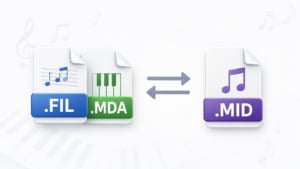
This is a free online tool to convert MIDI Type 1 (Format 1) to Type 0 (Format 0) for Disklavier and other player pianos. It allows for batch upload, and you can download the converted files individually or as a ZIP. This is useful for Yamaha Disklaviers, Casio keyboards, older digital pianos, and dealing with DAWs that export Type 1 by default.
Many older player pianos (and even some newer systems) play Standard MIDI Files (SMF) most reliably when they’re saved as Type 0 (Format 0). Type 1 files store the same song across multiple tracks, which can cause some instruments to play only part of the performance. There are many high-quality MIDI files available for free, and many other MIDI files available for purchase, but these sometimes require conversion.
This tool converts SMF Type 1 to SMF Type 0 by merging tracks into a single track while retaining MIDI channel data. The notes and timing stay the same, but the file becomes easier for many player systems to interpret.
Note that Type 0 versus Type 1 is about tracks—not channels. By default, this tool combines tracks while preserving MIDI channels. Enable “Play all parts on the piano” to route the parts to channel 1. Review the percussion option before doing this with an ensemble arrangement.
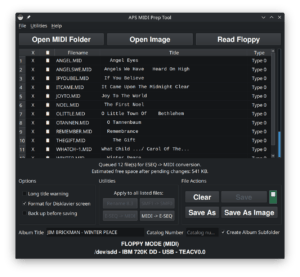
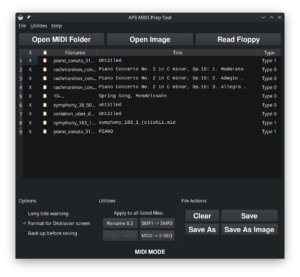
If it still plays only one hand after conversion, you may need a channel-remap tool, such as APS MIDI Prep Tool or GNMIDI.
This tool is useful for Disklaviers, Clavinovas with SMF playback, and other player systems that import or play Standard MIDI Files and behave best with Type 0. Compatibility varies by model and controller.
This feature is now included in APS MIDI Prep Tool. If you have hundreds of files to convert, consider downloading this tool instead.
I’ve also previously recommended using GNMIDI, or other common tools. Most of these either cost money or are confusing to use. Because this is a common issue for my customers, I wanted to put a simple, free tool right into their hands.
MIDI Type 1 to Type 0 Conversion Tool
Upload one or many files. Download links appear as they're ready.
Use this when a Disklavier sends some instrumental parts through its speakers. This routes every part to MIDI Channel 1 so the piano itself plays them instead. Available when all parts are routed to the piano. This removes MIDI Channel 10, which General MIDI files commonly use for drums, so percussion notes do not play as piano keys. Try this when a song will not load, start, or play correctly. Some Disklaviers and older MIDI players have trouble with extra text and metadata. The first title and all playback data are kept. Play all parts on the piano
Exclude percussion
Strip extra metadata
All uploaded files are kept no longer than 24 hours. See Privacy Policy for more details. This tool only supports SMF (.mid) files. Conversions are limited to 10 files per minute, and no more than 20 MB at a time. Only upload files you have the legal right to use and upload.
What is a Type 0 MIDI file?
A Type 0 MIDI file is a single-track Standard MIDI File. Type 1 MIDI files use multiple tracks, often separating parts, instruments, hands, accompaniment, or setup data. Some older playback systems only read one track correctly, which can make a piece seem to play only one hand or one part. Many player pianos—especially Yamaha Disklaviers and similar systems—expect Type 0 format for reliable playback and accurate performance. You can read more at Sweetwater or Basic Synth.
How do I know if a file needs conversion?
If a file plays correctly on your computer but only one hand plays on the piano—or nothing at all—it’s usually because the instrument can’t interpret the multi-track structure. Converting it to Type 0 might fix that.
Some player pianos can only play Type 0 files. Check my Disklavier compatibility chart to see if this applies to your model of Yamaha Disklavier.
Can I use these converted files on any player piano?
Converted Type 0 files are widely useful for systems that import or play Standard MIDI Files from floppy, USB, memory, or other storage.
Will the converter change the music itself?
The conversion merges a Type 1 MIDI (multiple tracks) into Type 0 (a single track) so your piano can read it. The conversion is intended to preserve notes, timing, velocities, MIDI channels, and controller data, but it changes the file structure and may simplify or reorder some metadata. Test converted files on the actual instrument before relying on them for a performance or customer archive.
Is MIDI Type 0 the same as E-SEQ?
No. MIDI Type 0 is still a Standard MIDI File, just organized as a single track. Yamaha’s E-SEQ format is proprietary and used primarily on floppy-based Disklaviers. This tool converts between MIDI formats only—it does not create E-SEQ files.
What about Type 2 MIDI files?
Type 2 (Format 2) MIDI files store multiple independent sequences. They are uncommon, and this converter doesn’t support them. If you run into one, you’ll need to convert it to a standard song format first (Type 0 or Type 1) using a desktop tool. GNMIDI Professional includes options to convert/reshape Type 2 files.
Source Code
If you’d like to expand this tool or contribute, or view the changelog, you can see the source code on GitHub.
Citations
The MIDI Association. About MIDI – Part 4: MIDI Files (Standard MIDI File Format). The MIDI Association, https://midi.org/about-midi-part-4midi-files. Accessed 4 Mar. 2026.
Sweetwater. “What’s the Difference between MIDI Type 0 and MIDI Type 1 Files?” Sweetwater Knowledge Base, updated 22 June 2017, https://www.sweetwater.com/sweetcare/articles/what-difference-between-midi-type-0-midi-type-1. Accessed 4 Jan. 2026.
“Standard MIDI Files.” BasicSynth, https://www.basicsynth.com/index.php?page=SMF. Accessed 4 Jan. 2026.
Piano and sheet music, Public Domain (PublicDomainPictures.net) — Photo via https://www.publicdomainpictures.net/pictures/180000/velka/piano-1467284727BBP.jpg