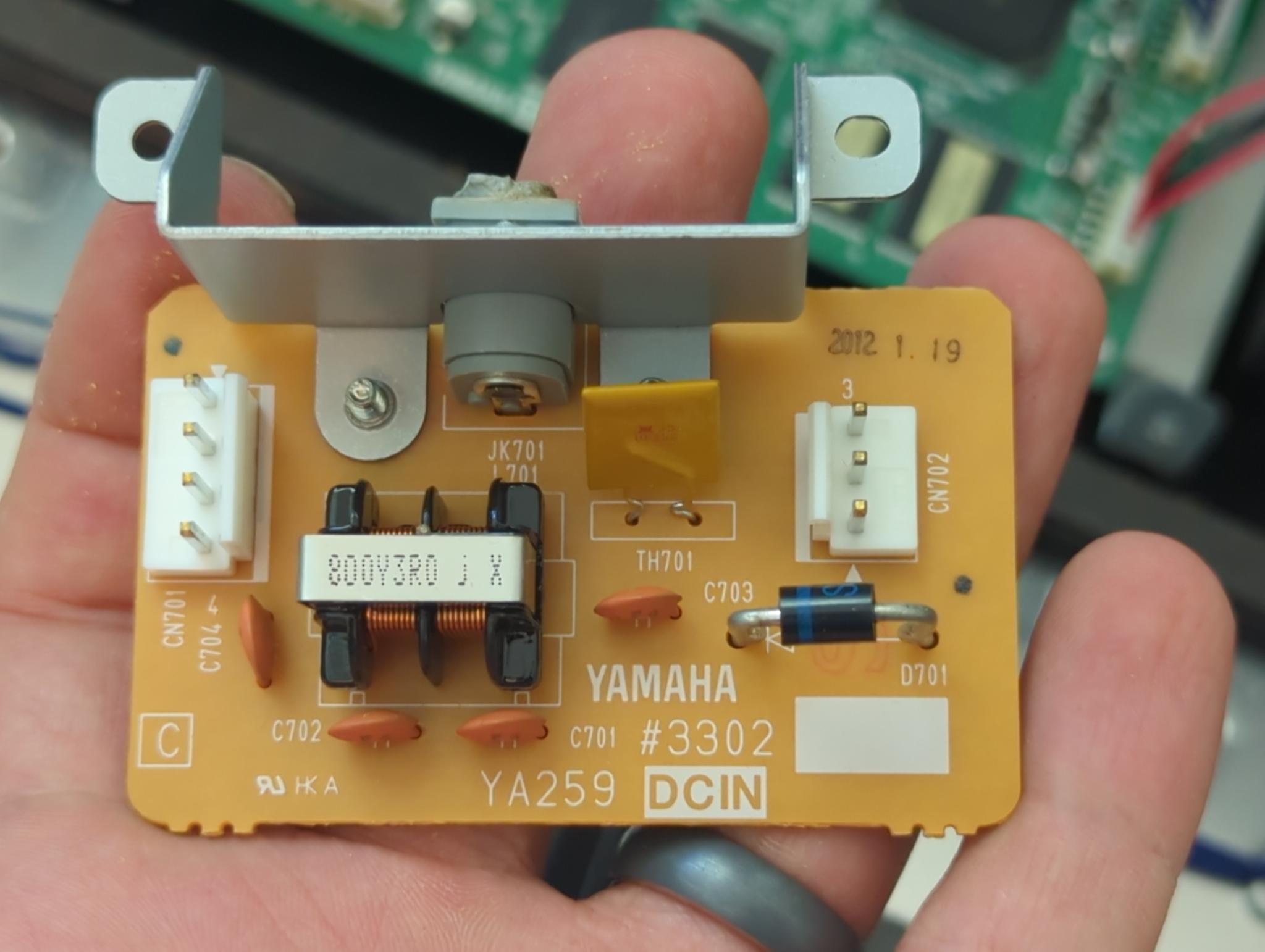
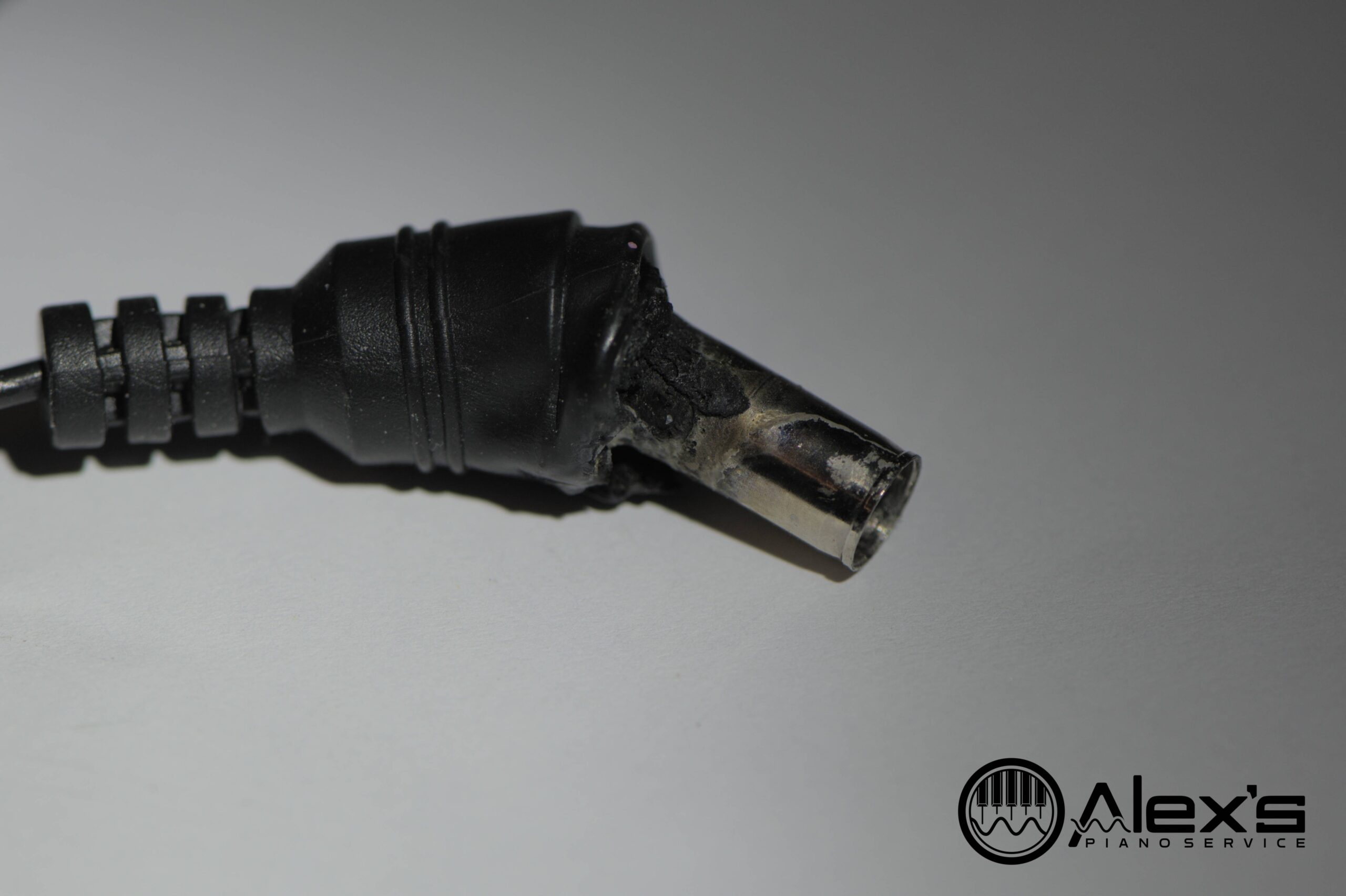
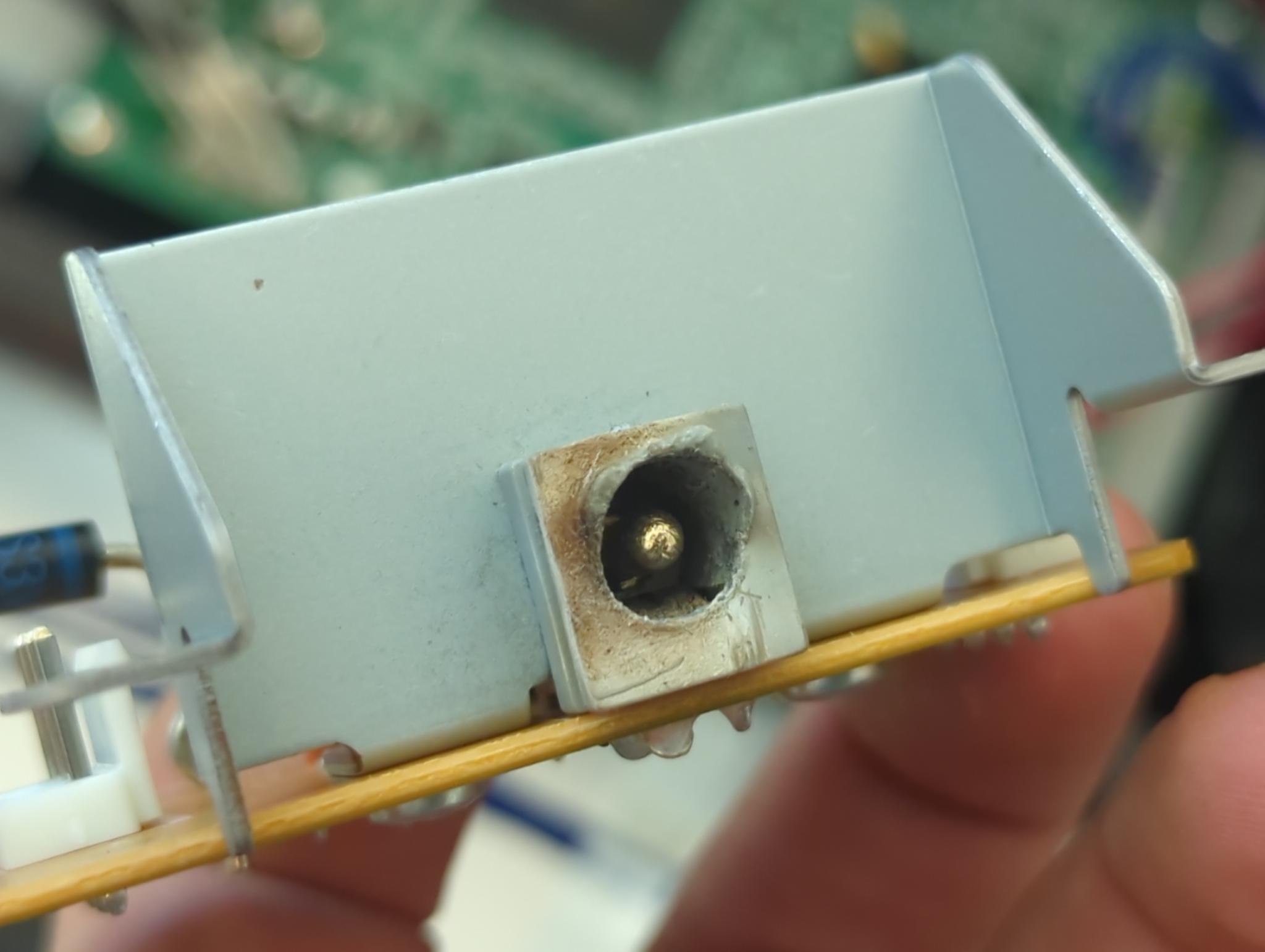
I recently had a customer reach out to me reporting that her Yamaha P-155 would not power on. When I inspected the piano, I found a destroyed power adapter and a burned power inlet. I’m not certain what caused it: Damage like this could be caused by not fully inserting the plug, by a power surge, or by a short.
Update (7/10/26): I have since learned that there is a recall on the Yamaha PA300C power adapter. See Yamaha’s recall here: https://www.yamaha.com/us/support/pa300Crecall/
The pictures below show how these recalled power adapters often fail. Although issues could be caused by power surges, in this particular case, it was caused by a failed power adapter and a known recall.
The Problem: A Burned Power Inlet
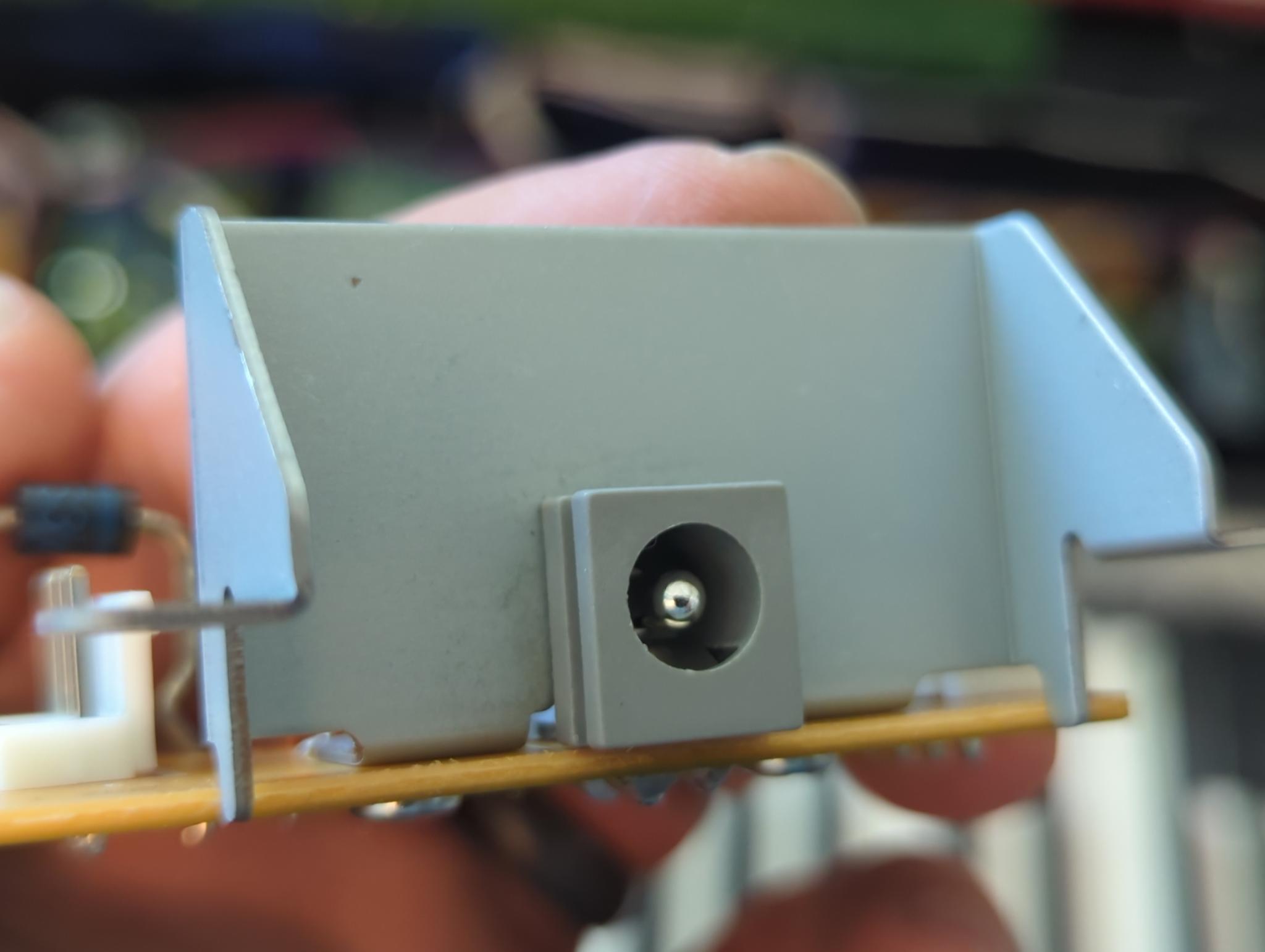
The Replacement Parts: An Inlet and Power Adapter
The replacement jack is V7509100, but is no longer available through Yamaha. However, the keyboard parts company Syntaur has a supply of these power inlets available.
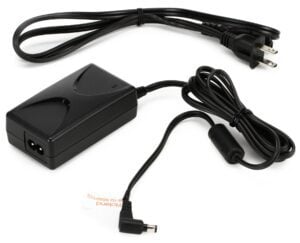
The P-155 uses the PA-300 power adapter. You can purchase this from your local Yamaha dealer, or you can purchase the PA-300 from Syntaur. Note that if you no longer have your original power cord, you’ll also need to purchase this cord to go with the adapter. Don’t skimp and purchase a generic power adapter!
Preventing Future Damage
Seat the plug fully every time; half-inserted plugs arc and overheat.
If your power adapter has been recalled, replace it! You can check yours against the serial numbers listed on Yamaha’s recall page.
Use only the Yamaha PA-300 supplies. If you must, make certain to use only very high quality 16 V center-positive power supplies that can supply at least 2.4 amps.
Add surge protection. I have a full article on surge protectors for your keyboards.
FAQ
Does the PA-150 work?
No. The PA-150 is 12 V; the P-155 needs 16 V. Although the PA-150 is readily available, it is not the appropriate choice.
Can I use a higher-amp adapter?
You should use the original Yamaha PA-300. However, if you must use another power adapter, make certain the amp rating is equal to or higher than 2.4 amps. The amp rating is the available current. Under no circumstances use a lower amp rating.
What if the power inlet board is damaged?
The power inlet board is, unfortunately, discontinued. You’ll have to repair the inlet board manually. The resettable fuse and ceramic capacitors are fortunately all readily available.

This exact same issue happened with my P155 and PA300C — in my case the only AC device plugged into a “side socket” wall tap in a recently neglected home studio. I play an upright and have not needed to record MIDI for quite some time, so I can’t even say when I last powered the P155 up, but I would assume this happened in the last two years. I am very interested in hearing if this failure is suddenly happening to multiple owners (mine is about 15 years old and has not moved for the last ten.) Thanks for the heads up and the repair advice!
The PA300C has been recalled!
YAMAHA PA-300C AC POWER ADAPTOR RECALL
https://www.yamaha.com/us/support/pa300Crecall/
https://www.cpsc.gov/Recalls/2025/Yamaha-Corporation-of-America-Recalls-Power-Adaptors-for-Digital-Pianos-and-Music-Workstations-Due-to-Burn-and-Fire-Hazards
Well, at least until the current regime finishes gutting the CPSC.
Also recalled in Canada:
https://ca.yamaha.com/en/business/audio/news/2025/notice-pa300c-recall.html
I was just about to buy a replacement and I decided to search a little more thoroughly. Perhaps I can also get Yamaha to cover the cost of damage to my Power Inlet too…
Thanks, Dan! That is helpful to hear. Yamaha’s recall does specifically list the P-155/P-155S/P-155B with the PA-300C, and the described failure is abnormal heat at the DC plug, which is what I saw. I had assumed it was some apparent situation that caused my customer failure, but I guess maybe it’s part of a trend! I would photograph the adapter label and the damaged inlet. I would also be very interested to hear whether Yamaha covers the inlet damage as part of the recall. It’s not difficult work, but it does require soldering, so would typically fall in the purview of a technician. So we’ll see! Keep me updated. Thank you!
Leaving this template here in case anyone else discovers this thread after losing use of their piano, as well as the PSU.
TBH I have not yet flexed that my piano was purchased with my retail employee discount at what is probably Yamaha’s largest pro audio account in NYC. Until Sunday morning I was a die-hard Yamaha piano enthusiast who happy steered many customers (and piano pop peers) away from Roland to the superior sound and feel of GHS and GH3. (Casio isn’t even in the ballpark, and Nords are more for gigging players than price-conscious families, IMHO.)
Sadly, I have a feeling Yamaha’s response (or non-response, as of today’s end-of-day) will color my endorsement moving forward. This is a huge fail that could have been easily avoided, particularly since they announced the recall last May @YamahaMusicUSA have sent me at least 30 spam, urm, “piano marketing emails”. Yet they didn’t have the courtesy to send an email warning me that their PSU was making plans to kill my piano. ¯\_(ツ)_/¯
https://share.icloud.com/photos/06ci8OZyV-BTGsD5TKowdkgNQ