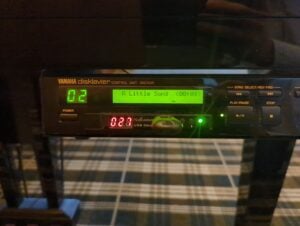
The DSR1 upgrades Mark I and Mark II Disklaviers with 1 MB of internal song storage, support for both low- and high-density floppy disks, and the ability to record and play Standard MIDI Files as well as older E-SEQ songs.
At a Glance
- Generation
- Mark I / Mark II upgrade unit
- Associated Models
-
Upgrade for Mark I and II
- Uses
-
Internal Storage2DD floppy2HD floppy
- Recording
-
E-SEQSMF0
- Plays
-
E-SEQSMF0SMF1
- PianoSoft Types
-
SoloPlus
- Upgrade Options
-
MIDI/app playbackBluetooth MIDIAnalog/audio accompanimentDCD-1Media/storage replacementNalbantov
- Bluetooth MIDI Apps
Additional Details
This upgrade includes 1 MB of built-in memory and can use both 2DD and 2HD floppy disks.
It can work with older E-SEQ songs and Standard MIDI files. Type 1 MIDI files are generally something it plays rather than records.
Things to Know
The DSR1 is an upgrade unit that adds Mark II XG capabilities to the Marks I and II. It includes a 1 MB internal flash memory disk.
If replacing the floppy disk drive, use the model-specific slim drive listed in my Nalbantov guide; generic emulators do not fit this control unit.
Recording and playing back E-SEQ is confirmed in the official DSR1 owner’s manual archive.
This is not to be confused with the MU50 (or TG100). These tone generators could be added to the Mark I and Mark II era pianos and would add support for PianoSoft Plus floppies, but did not add new drives or support for SMF0.
Early host pianos can require model-specific startup preparation before the DSR1 can control them. MX80/MX95 and MX100A/B installations may require a disk to remain inserted and their record or keyboard/MIDI-output state to be set after power-up; follow the matching host section of the DSR1 manual.
If a computer reports an original Yamaha Disklavier floppy as unformatted, do not format it. My Disklavier floppy-recovery guide explains why this happens, and my tested USB floppy-drive guide identifies hardware that can read 720 KB/2DD disks.