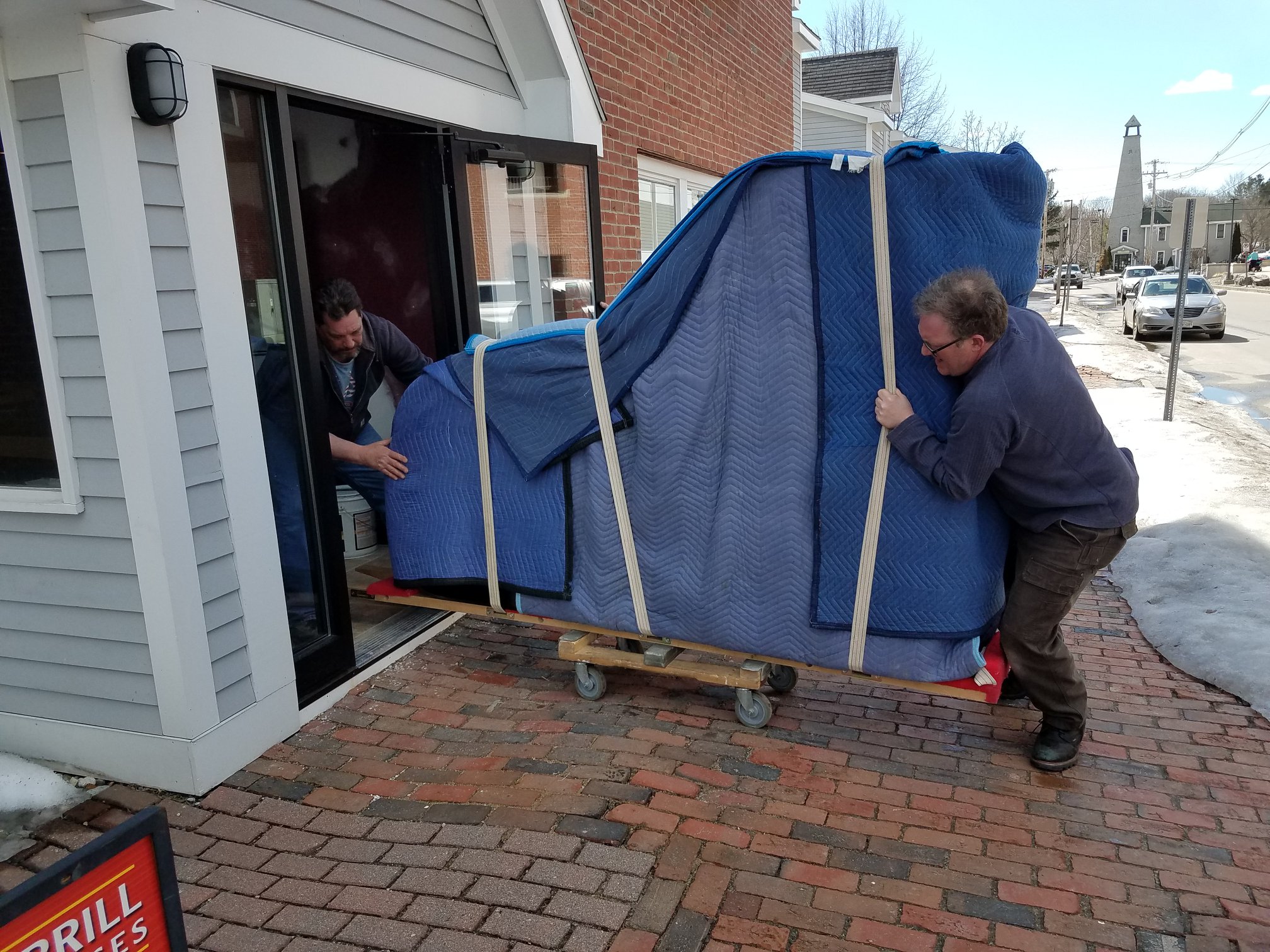
As a local piano technician, I’m frequently asked how long to wait before tuning a piano after a move. This article addresses that question. Please see my article on piano moving for more information about piano moves.
A brand-new piano is a separate case. New pianos usually need more frequent tuning in the first year as the strings and structure settle.
How long should you wait to tune a piano after moving?
- If the piano moved across a room
I recommend tuning it anytime. It’s not necessary to wait. - If it moved between homes or towns
I recommend waiting at least two weeks before tuning. - If it came from storage, spent time in a moving truck, or moved into a meaningfully different climate
I recommend waiting at least two weeks, but four is generally safer.
The move itself is usually not the real problem. The humidity change is. Moving your piano from one side of the room to the other is not inherently stressful to the piano. Even moving between rooms probably isn’t, unless the rooms are very different in terms of their average climate. In that case, please review my guide on proper piano humidity and consider investing in humidity control systems.
What does “settling” actually mean?
When people say a piano has to settle after a move, they often picture the strings somehow relaxing because the piano was jostled. If the piano is structurally in good condition, that’s probably not a significant factor.
The real settling is acclimation. A piano is full of wood, felt, leather, and cloth, and those materials respond to the relative humidity in the new space. The Piano Technicians Guild (PTG) identifies humidity-driven soundboard movement as a primary cause of pitch change, and both PTG and Kawai note that changes in humidity also affect touch, action response, and overall tuning stability.
Why does piano tuning change after a move?
The soundboard is built with crown—a slight upward bow. It’s higher in the middle than toward the edges. As the air gets more humid, the board absorbs moisture, the crown increases, and the bridge pushes harder into the strings. That stretches the strings slightly sharper, especially through the middle of the piano. When the air dries out, the opposite happens: The soundboard flattens a bit, bridge pressure falls, and the piano goes flatter.
So when a piano arrives in a new house and keeps drifting afterward, that is usually not “bad tuning.” It is the instrument adjusting to a new humidity level.
My recommendation by move type
A short move inside the same house usually does not call for a waiting period. In most cases, moving the piano across the room is not what changes the tuning. Moving it between environments is.
For a typical residential move, I recommend a minimum of two weeks in the piano’s final location before tuning. Although houses do differ in terms of their internal climates, this isn’t usually a radical difference in a given region. If you’re moving one apartment to another a few miles away, the humidity levels are probably fairly similar.
For long-distance moves, seasonal homes, moves involving storage, or any situation where the piano sat in uncontrolled heat or humidity, I prefer 2-4 weeks. If the HVAC is not running normally yet, or the humidity in the room is still bouncing around, wait longer. Tune it after the room stabilizes, not before.
When a first tuning still may not be the last
If the piano arrives far from A440, the first appointment may need a pitch correction before the fine tuning. The PTG notes that large pitch corrections change the balance of string tension across the whole instrument, which is why a piano that is substantially sharp or flat may need follow-up service before it becomes truly stable again. In other words, “getting it in tune today” and “making it stay there” are related, but they are not identical jobs. Please see my piano tuning FAQ for more information on pitch correction.
The practical takeaway
Have the piano moved into its final spot before tuning. Keep it away from direct sunlight, exterior doors, fireplaces, windows, and HVAC vents. Get the humidity into a stable middle range. In practice, I like 42-45 percent relative humidity for tuning stability, though manufacturers publish somewhat broader acceptable ranges. Then tune the piano after it has acclimated. Tuning too early is just aiming at a moving target.
Can a piano be tuned the same day it is moved?
It can be tuned the same day, but it usually should not be. After a move, the piano begins adjusting to the humidity and temperature of the new environment. As the soundboard absorbs or releases moisture, the pitch will drift slightly. Waiting about two weeks before tuning allows the instrument to stabilize so the tuning will last longer.
If the piano only moved within the same house and the climate is unchanged, tuning sooner is often fine.
One exception is rental pianos that are used for a performance—see the question below.
Should a rental piano be tuned immediately after it is moved?
One important exception involves rental pianos used for performances. These instruments are typically tuned immediately after they are moved, often on the same day as the performance.
Even though the piano has not fully acclimated to the room’s humidity, the priority is having the instrument sound its best for the event. Because the piano is still adjusting to the environment, however, the tuning will usually drift fairly quickly.
For this reason, if a rental piano is being used for multiple performances over several days, it is standard practice to tune the piano before each performance. This ensures the instrument sounds its best every time it is played in front of an audience.
Works Cited
Kawai America Corporation. Caring for Your KAWAI Piano. PDF, n.d. Accessed 12 Mar. 2026.
Piano Technicians Guild. “Piano Servicing & Maintenance.” PTG Main Site, n.d. Accessed 12 Mar. 2026.
Piano Technicians Guild. “Pitch Raising.” Teacher Resources, Piano Technicians Guild, n.d. Accessed 12 Mar. 2026.
Steinway & Sons. “Service & Maintenance.” Steinway & Sons, n.d. Accessed 12 Mar. 2026.
Kovarsky, Jerry. “Five Simple Steps for Maintaining Your Piano.” Yamaha Music (Hub), 12 Sept. 2023, https://hub.yamaha.com/pianos/p-how-to/five-simple-steps-for-maintaining-your-piano/. Accessed 30 Dec. 2025.