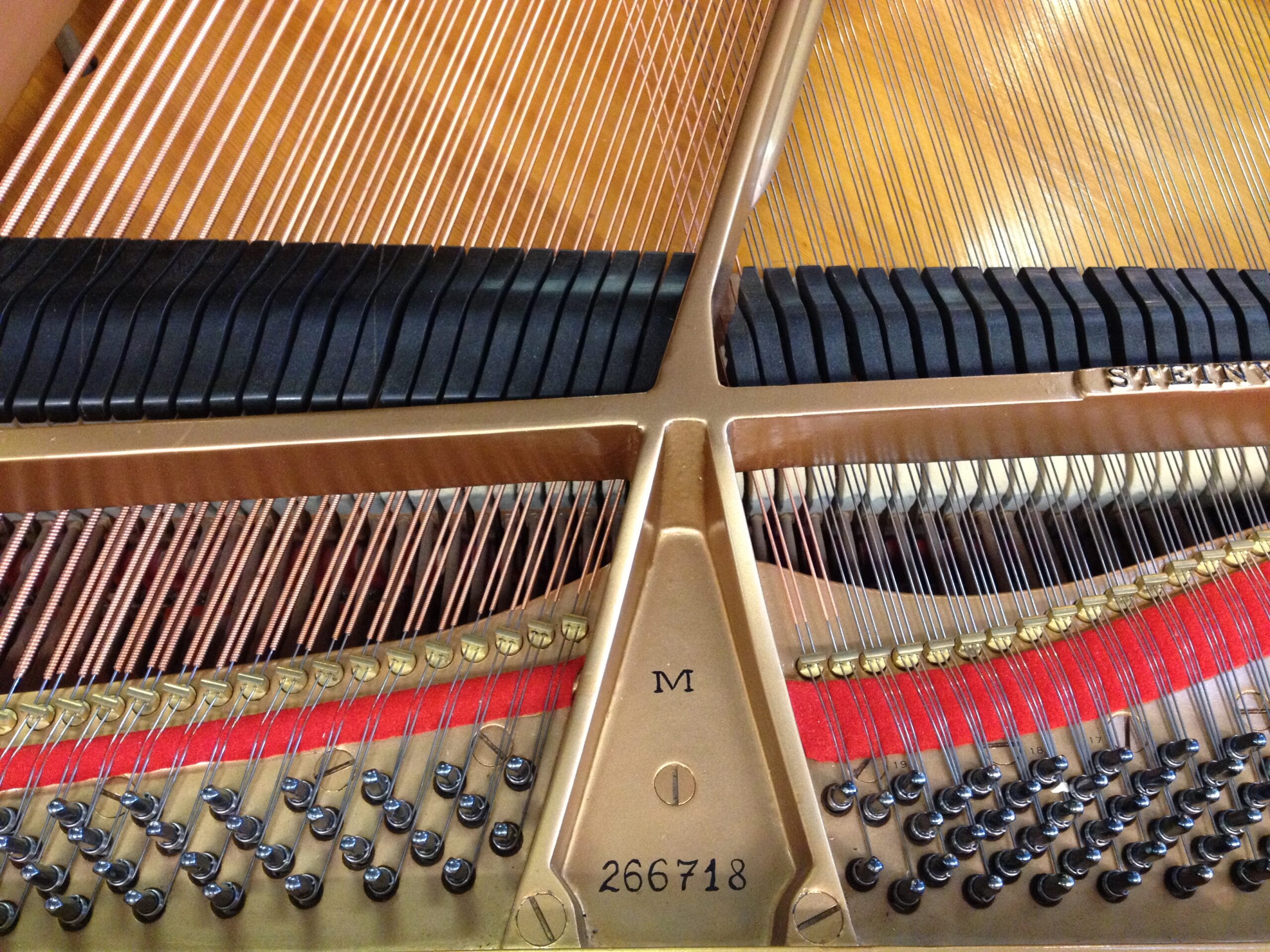
Customers regularly ask me which is the best humidifier for their piano and music room. Pianos are creatures of humidity: Wood is hygroscopic, meaning it naturally absorbs and releases moisture from the air depending on the humidity level. Controlling that relative humidity in and around your piano is one of the most important aspects of piano care and maintenance.
My recommended humidity target for the piano room is between 42% and 45%. This can vary slightly based on manufacturer. See my humidity guide for a list of manufacturer recommendations and more detailed reasoning.
Some links in this article are affiliate links. As an Amazon Associate I earn from qualifying purchases. Your click fuels hours of reviewing old service manuals—at zero added cost to you.
Quick answer
Best all-around: AIRCARE H12-400HB. High-output evaporative humidifier that can keep up in large, open rooms. Big capacity and safe with tap water, but louder than smaller units.
Target humidity for pianos: The ideal is 42-45% RH, but a very good range is 40-50% RH. See my piano humidity guide for manufacturer recommendations and a deeper explanation.
| Large open living room/great room | AIRCARE H12-400HB | High output and large capacity for open spaces. No mist, no white dust, but you will hear the fan. |
| Open space, less floor space | AIRCARE MA1201 | Similar performance to the H12 in a smaller cabinet. More frequent refills, still a bit loud. |
| You care about aesthetics | AIRCARE EP9 pedestal | Looks like a side table and still humidifies a fairly large area. Good compromise of looks and output. |
| Small enclosed music room | Venta LW25 | Quiet, filter-free evaporative unit that’s easy to live with. Best when the door can stay closed. |
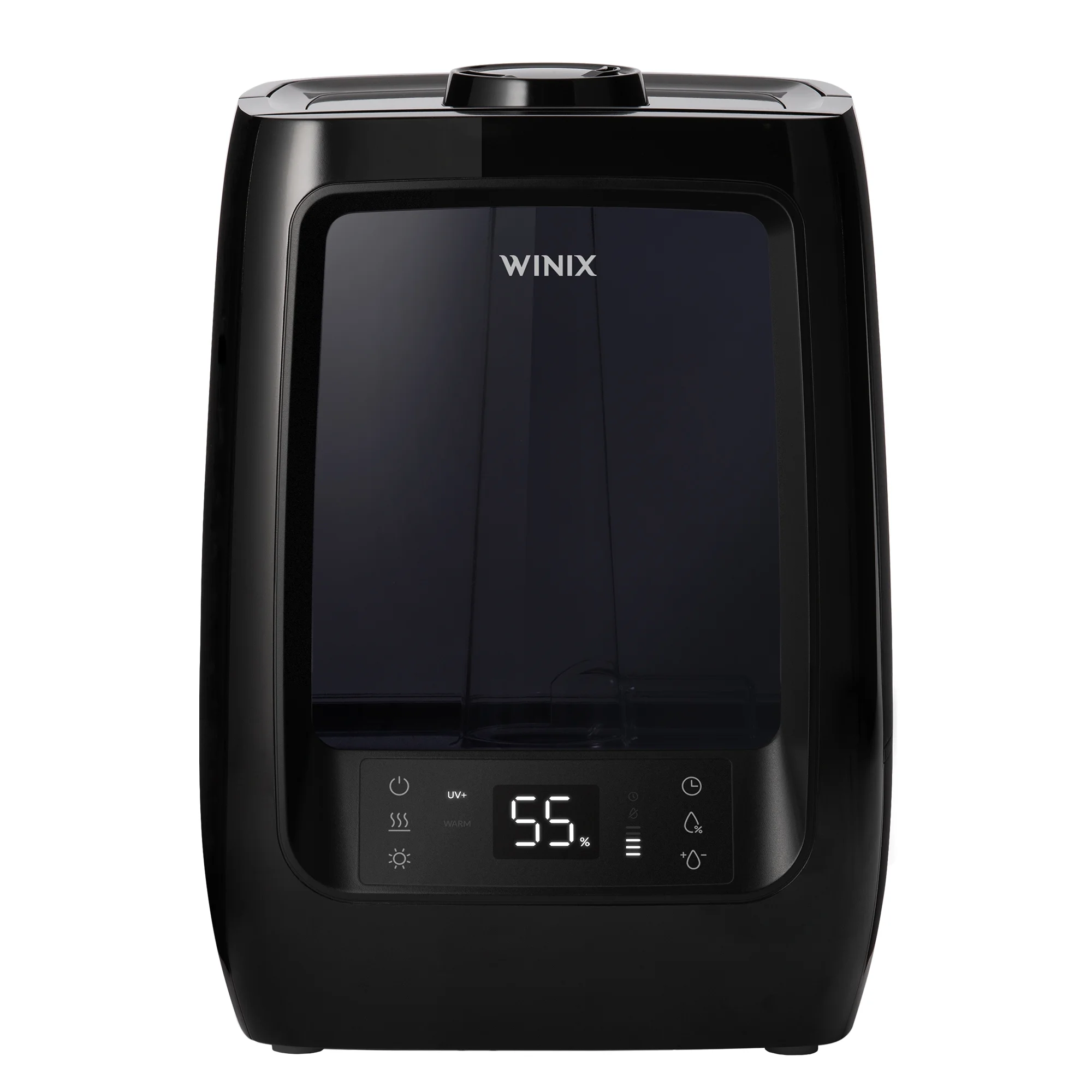
| Silent ultrasonic option | Winix L200 (ultrasonic) | Very quiet and humidifies fast, but use distilled/demineralized water to avoid white dust. Keep it well away from the piano. |
Placement: Put the humidifier in the same room, but at least 5 feet from the piano. Avoid blasting moisture directly at the instrument, especially toward the rim, case, or soundboard area.
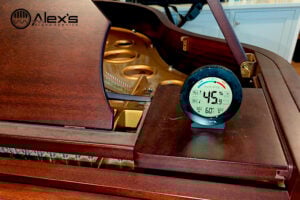
Measure at the piano: Don’t trust the humidifier’s built-in humidity reading. Use a dedicated hygrometer near the instrument (see: best hygrometer for a piano room).
Maintenance: Clean regularly. For evaporative units, a bacteriostatic treatment like BestAir 3BT helps keep the tank and wicks from getting nasty. Don’t use water treatments in ultrasonic humidifiers.
If the room can’t be controlled: A room humidifier is the best starting point, but if the space is difficult (very open, seasonal, church, etc.), consider controlling humidity inside the piano with a Dampp-Chaser system.
Piano Room Humidifier vs. Dampp-Chaser Systems
Controlling the humidity in the piano or music room is always the best option. Even the Dampp-Chaser Corporation recommends controlling the humidity in the room first, before installing a Piano Life Saver system.
Dampp-Chasers do protect your piano in rooms that have poorly controlled humidity, although they provide even better protection in rooms with fairly stable humidity. For more on Dampp-Chaser systems, see my Dampp-Chaser FAQ, as well as my guide on Dampp-Chaser pricing and the top 10 most common Dampp-Chaser mistakes.
If you’re in Maine, see my price list and reach out to me for a Dampp-Chaser installation.
Dampp-Chaser Piano Life Saver Systems are not a 100% replacement for humidity control in the piano’s environment. But they can help.
Humidifier Placement
The optimal placement of a humidifier for a piano is in the same room but not directly next to the instrument. This allows the humidity to rise gradually and evenly throughout the space, preventing localized over-humidification that could damage the piano’s finish or internal components. Place all humidifiers at least five feet away from the piano.
Pair it with a Good Hygrometer
Since the humidity gauges built into most humidifiers are often inaccurate or only measure conditions near the unit, you should place a reliable hygrometer near the piano to monitor humidity levels accurately. See my list of recommended hygrometers. In my experience, humidifiers typically have optimistic readings of the humidity since they’re right next to a humidifier! Use the hygrometer near your piano to guide your humidifier adjustments.
Humidifier Treatment
Even the best humidifiers have the potential to grow mold and bacteria. A treatment such as BestAir 3BT is bacteriostatic. It protects the filters inside your evaporative humidifier, and keeps all the creepy crawlies out of your humidifier! This is appropriate for use in the evaporative humidifiers listed below. Do not use this with ultrasonic humidifiers, as it will become airborne.
Evaporative Humidifiers
Evaporative humidifiers use simple evaporation, typically from a fan driving air through paper filters. The Venta is unique in that it uses a rotating disc stack and a low-speed fan, making it dramatically quieter and meaning it requires no replacement filters. However, it does have a smaller coverage area than the other humidifiers in this list.
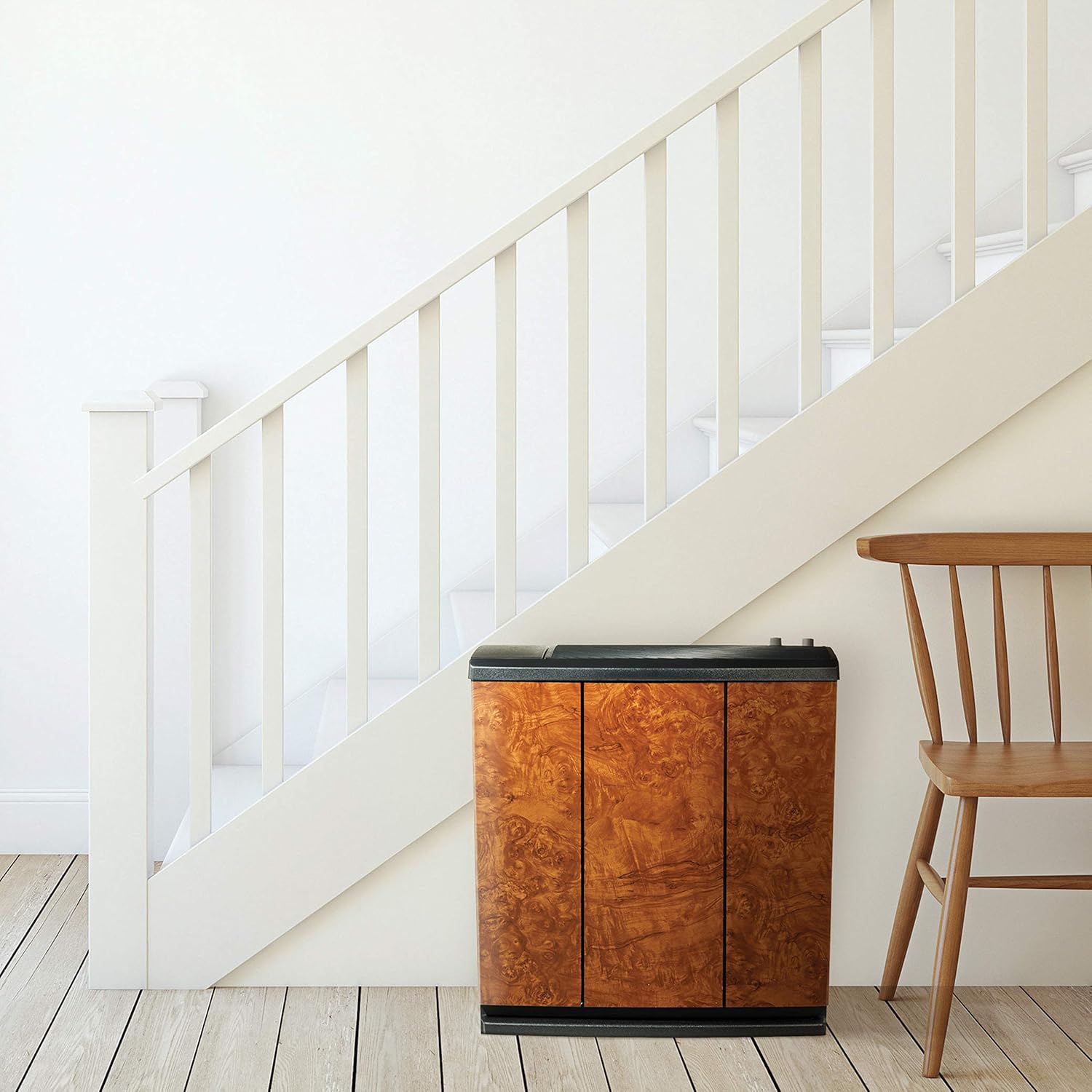
AIRCARE H12-400HB
In brief: Consider this unit if your piano is in a fairly large, open space, and you don’t mind a little noise or a fairly large device in your house. This is the humidifier I recommend most often.
The AIRCARE H12 is a conventional evaporative humidifier capable of handling areas up to 3,700 square feet (ca. 334 m²). This system has a much larger capacity and will cover a much larger area than the Venta above. And you can still safely use tap water.
This is the best option for the majority of my customers, and I’ve had numerous customers recommend it to me! This March, I was tuning for a fellow in Newry, ME, not far from the Sunday River Resort, who was so excited about it, he actually ran through the filling process in front of me. The total capacity is 5.4 gallons, but the reservoir that you bring back and forth to the sink is smaller, making this an easy option for people who don’t like the idea of carrying large containers filled with water!
The tradeoff is that this unit is fairly loud. Unlike the Venta, it relies on a fan. This makes it considerably more effective with an almost ten-fold increase in coverage area, but you can definitely hear the difference!
The unit’s design includes a removable water tank for easy refilling and a refill indicator to alert users when water levels are low.
The H12 is available for about $175 at Amazon.
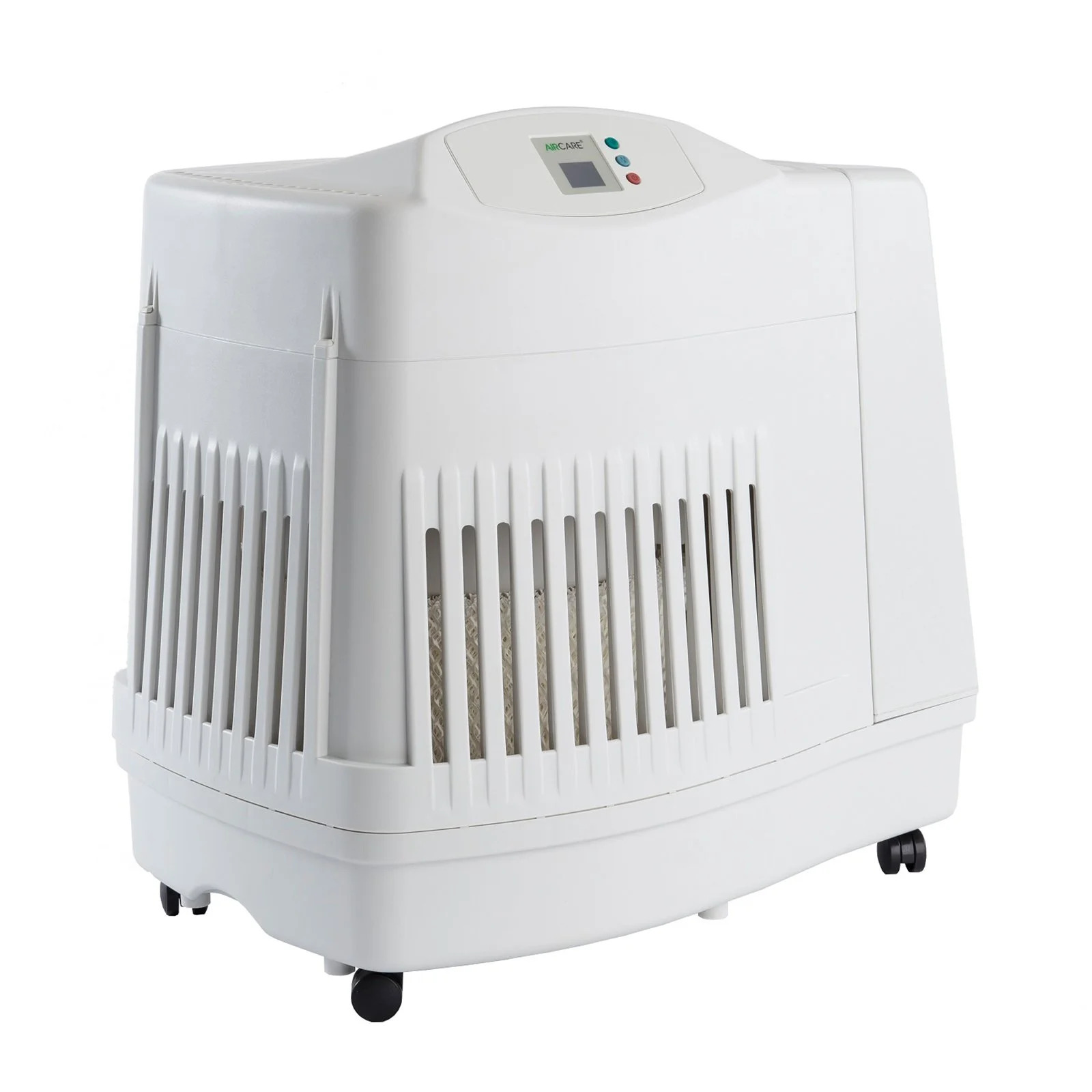
AIRCARE MA1201 Whole-House Console-Style Evaporative Humidifier
In brief: Consider this unit if your piano is in a fairly large, open space, and you don’t mind a little noise, but don’t have space to spare.
The AIRCARE MA1201 is a console-style humidifier capable of humidifying areas up to 3,600 square feet (ca. 334 m²). It has roughly the same output and power as the AIRCARE H12 above, but is a considerably smaller device. It will require more regular filling, but is very nearly as effective. Consider this if you want performance similar to the H12 above, but in a smaller package. The capacity is lower, meaning it will require more frequent fills, and can’t be left unattended for quite as long. But otherwise it will perform almost just as well.
The MA1201 is available online through Amazon for about $145.
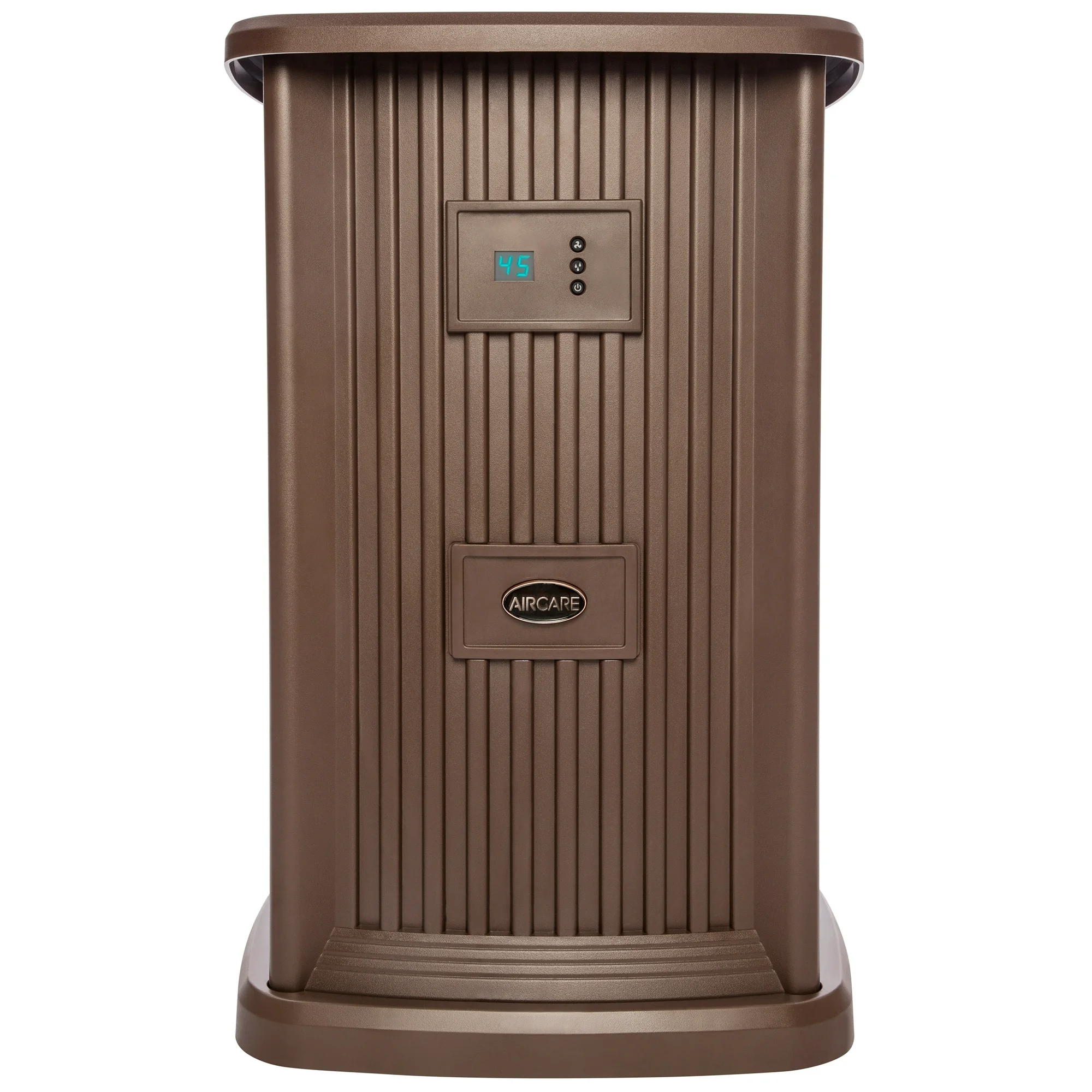
AIRCARE EP9 Whole House Pedestal Evaporative Humidifier
In brief: Consider this unit if your piano is in a moderately open space, and you don’t mind a little noise, but you’d prefer something pretty!
The AIRCARE EP9 is a pedestal-style humidifier with a 3.5-gallon capacity, suitable for spaces up to 2,400 square feet (ca. 223 m²). It’s considerably prettier than the MA1201, and it looks more like an actual piece of furniture. It has a reasonable capacity, and services a relatively large area. There are nine different fan speeds, giving you some options in terms of noise level.
Overall, this represents a very good compromise of aesthetics and effectiveness. Of the options listed so far, it performs very well in all respects, even though its output is lower than the MA1201 above.
The EP9 is available online at Amazon for about $175.
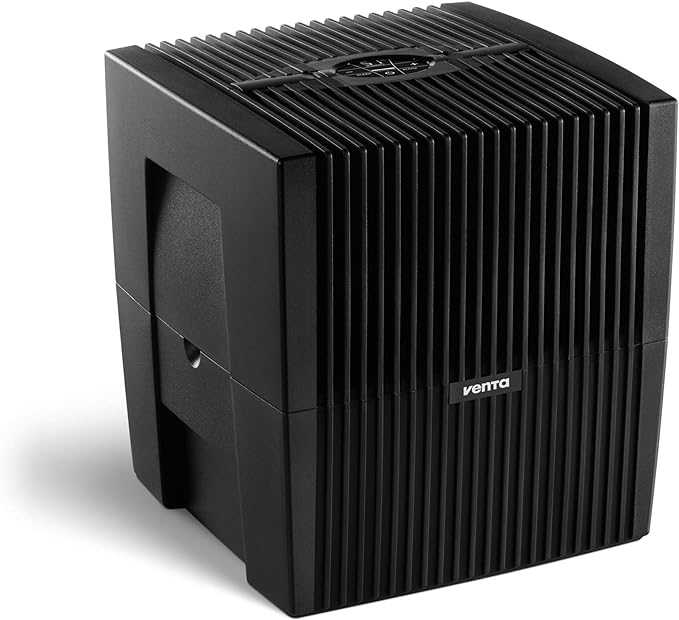
Venta LW25
In brief: Consider this unit if your piano is in a relatively small room, especially if you typically keep the doors closed.
The Venta LW25 Original Air Humidifier maintains optimal humidity levels between 40% and 60% in rooms up to about 430 square feet (ca. 40 m²). It operates using cold evaporation without the need for mats or filters, and you can safely use tap water. The fact you can use it with tap water is a major bonus!
The LW25 is effective and relatively easy to maintain compared to other humidifiers in its price range. It’s also very quiet. The build quality is excellent, and it will make a faithful companion for your piano through many winters.
However, they’re more passive devices than the humidifiers listed below, and are less effective in very dry or open environments. They were originally designed as air cleaners, and so humidify less aggressively than the devices listed below.
You can read plenty of reviews on Piano World forums. In fact, they have a cult following. They’re perfect if your piano is in its own music room or other smaller space, especially if you can shut the door.
You can purchase the Venta LW25 from Amazon for about $400.
Ultrasonic Humidifiers
In general, I do not recommend ultrasonic humidifiers for acoustic pianos. They require very clean water—typically distilled. They also tend to be too small, and can create condensation and uneven humidity in a room. However, they are silent and do very rapidly and effectively humidify a space, and many customers love the silence and low price. If you’re looking for a silent humidifier, there’s one product that stands out above all the others:
Winix L200 2 Gallon Ultrasonic Humidifier
In brief: Consider this unit if your piano is in a relatively small space, and you need something relatively inexpensive and absolutely quiet.
The Winix L200 2-Gallon Ultrasonic Humidifier humidifies areas up to 600–750 square feet (ca. 70 m²). The Winix is the best option I can find if you insist upon using an ultrasonic humidifier. It adds humidity to the air quickly and silently, and is comparatively inexpensive. The Winix L200 is about $100 from Walmart.
However, there’s a considerable tradeoff. The downside of ultrasonic humidifiers in general is that you must use distilled water or filtered, demineralized water. Otherwise, minerals will be flung into the air by the humidifier, and white dust will accumulate on surfaces! (This is actually mentioned, officially, by the United States Environmental Protection Agency.) And it’s no fun cleaning this out from underneath the strings in a grand piano. This is not a unique problem for the Winix, but applies to all ultrasonic humidifiers.
You absolutely must locate this more than five feet from the piano. (“Five feet” is my number, based on observation and similar rules for heat sources. Steinway recommends keeping the humidifier out of the piano’s “direct proximity.”) Because it humidifies rapidly, it can easily damage the finish.
Unlike other ultrasonic humidifiers, the Winix L200 has a two-gallon capacity. This is extremely rare in the world of ultrasonic humidifiers, and although it’s still not as much as I’d like, it reigns supreme among its cohort.
The humidifier performs best when placed on a raised surface, such as a side table. Place it sufficiently high above the ground that the mist has time to absorb into the air; otherwise, you’ll get condensation (and potentially damage to wooden surfaces) around the base. With the Winix, you do have the option to warm the mist, and this helps considerably: This is one more reason why it’s the best of the ultrasonic options.