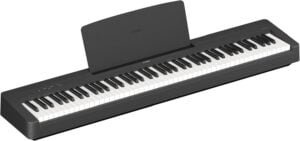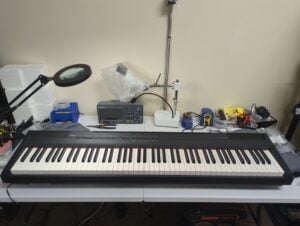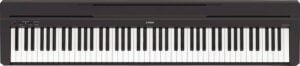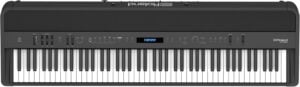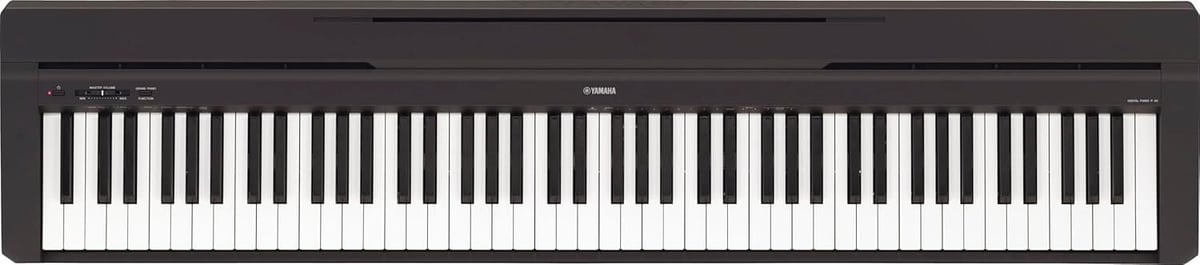
If you’re choosing between the Roland FP-10 and the Yamaha P-45 (P45B), you’re looking at two of the best-selling, best-supported entry-level 88-key weighted digital pianos on the market.
I’m an authorized Yamaha and Roland technician, and I repair both regularly. In my experience, both companies provide excellent support for these instruments—warranties are straightforward, and parts availability is generally strong for common service needs.
Quick clarification: Many people search “Roland DP-10” when they actually mean the Roland FP-10. The DP-10 is a damper (sustain) pedal—a popular upgrade for the FP-10. This post compares FP-10 vs. P-45B, and also covers pedal upgrades (including the DP-10).
Please see my guide on buying budget digital pianos for more information. If you’re considering whether to purchase the base FP-10, or whether you should upgrade to the FP-30X, FP-60X, or even FP-90X, please see my article comparing these popular Rolands.
Some links in this article are affiliate links. As an Amazon Associate I earn from qualifying purchases. Your click fuels hours of reviewing old service manuals—at zero added cost to you.
Prices and availability change constantly. Use the links below to see current listings.
Quick takeaways
Buy the Roland FP-10 if…
- You care most about key feel and want the most “acoustic-like” action you can get in this tier.
- You want Bluetooth MIDI for learning apps (less cable hassle).
- You want more polyphony and a more feature-rich platform.
Buy the Yamaha P-45B if…
- You want a simple, reliable starter piano with a huge user base.
- You don’t care about Bluetooth and are fine with wired USB connections.
- You prefer a lighter action feel (many beginners do).
FP-10 vs. P-45B specs
This table focuses on the practical differences that affect learning, feel, and long-term satisfaction.
| Feature | Roland FP-10 | Yamaha P-45 (P45B) |
|---|---|---|
| Key action | PHA-4 Standard (with escapement) | GHS (Graded Hammer Standard) |
| Polyphony | 96 notes | 64 notes |
| Built-in sounds | More variety (36 total tones) | Simple set of voices (great for beginners) |
| Speakers | Comparable home practice output | 6W x 2, 12 cm x 2 |
| Bluetooth | Bluetooth MIDI (excellent for apps) | No Bluetooth |
| USB | USB MIDI to computer/tablet | USB TO HOST (computer/tablet) |
| Half-pedaling | Yes, with optional DP-10 (or compatible) | Yes, with optional Yamaha FC3A |
| Included accessories | Includes basic pedal (varies by bundle/retailer), AC adapter | Music rest, pedal/footswitch, AC adapter |
Key action & feel (what your hands actually notice)
For most students, the key action is the difference-maker. It also impacts how long the keyboard lasts: A well-designed action is designed to be used for many years without mechanically degrading, and is also designed to be serviceable.
Good technique, control, and dynamic playing come from the way the keys push back (and how predictable that pushback is).
Roland FP-10: PHA-4 Standard (often preferred for realism)
The FP-10’s PHA-4 action is one of the biggest reasons it’s recommended so often. Many players describe it as more “piano-like,” especially for dynamics and control at softer volumes. The action includes a feeling of “escapement,” which is a physical sensation associated mainly with acoustic grand pianos.
Yamaha P-45B: GHS (straightforward, lighter, predictable)
Yamaha’s GHS action is simple, consistent, and widely used. A common theme from beginners and returning players is that the P-45 can feel lighter than the FP-10—sometimes that’s exactly what you want for comfort and longer practice sessions.
Sound & speakers (real-world expectations)
Both sound good for home practice and lessons. The bigger difference is character and how each responds to touch. Many listeners describe Yamaha as a bit more bright/clear, while Roland is typically described as warm/rich. But these are subjective, and your room and headphones matter a lot here.
Connectivity & learning apps (Bluetooth vs. wired)
If you’re using learning apps, notation apps, or a DAW, this is where the FP-10 often pulls ahead for convenience.
FP-10: Bluetooth MIDI makes connecting to apps much easier (fewer adapters and cables).
P-45B: Reliable wired USB connection. No Bluetooth, but stable when set up correctly.
What owners say (forum patterns you should know)
To make this comparison more useful, I also looked at multi-year discussions from piano and keyboard forums where owners share real-world experience: what they loved, what surprised them, and what annoyed them after the “new piano honeymoon” wore off.
Common FP-10 praise
Action feel is frequently called the best in this price range.
Bluetooth MIDI is a practical advantage for modern practice.
Better “spec headroom” (polyphony + features) helps it grow with the student.
Common FP-10 complaints
Some owners report clicking/knocking key noise on PHA-4 actions (more on that below).
Some players find the action heavier than they prefer.
Common P-45B praise
Many people like Yamaha’s clear piano sound for lessons.
Very simple to operate, great “sit down and play” instrument.
Lighter feel can be a plus for comfort, especially early on.
Common P-45B complaints
Occasional threads about power issues (won’t turn on / blinking light), often power-supply or internal board related.
Some owners describe the key mechanism as a bit more plastic/clunky than the Roland.
Forum threads worth skimming (for transparency)
- Piano World: Yamaha P-45 vs. Roland FP-10 beginner choice
- Piano World: Roland PHA-4 “clicky keys” discussion
- Piano World: FP10/FP30 PHA-4 “fix” thread
- VI-Control: P-45 vs. FP-10 MIDI / velocity behavior
- Reddit: FP-10 vs. P-45 discussion thread
Common issues (and how to avoid them)
No instrument is immune to problems—especially at entry-level price points. The important thing is to separate common myths from repeatable patterns, and to avoid mistakes that create “problems” (like unstable stands and bad power).
Roland FP-10: “clicking” or “knocking” keys (PHA-4 action)
Across multiple years of forum posts, a recurring topic is mechanical clicking/knocking noise on some PHA-4 actions. Sometimes it’s described as more noticeable on black keys.
My advice: If your FP-10 is under warranty and you develop abnormal key noise, don’t experiment—use warranty support or an authorized technician. DIY repairs can create bigger issues or complicate warranty coverage.
In my experience, these knocking sounds are usually associated with the grease in the keyboard. The viscosity of the grease changes considerably with temperature, so leaving the keyboard in a cold environment can make it especially “clicky.” It’s also not uncommon to find degraded felt, which can be replaced, and is a nearly-universal issue among keyboards.
Yamaha P-45B: “won’t turn on” / blinking power light
Another recurring online theme is power-related failures (won’t power up, intermittent power, blinking power light). Often the first suspect is the power adapter, the DC jack, or damage caused by poor power quality.
My advice: Use the correct OEM adapter—yes, this means buying a Yamaha brand power adapter even though it’s expensive. Make sure the plug seats fully, and don’t leave instruments unprotected during storms. All keyboards should be connected to some form of surge protector. If you see intermittent power issues, get it diagnosed early—small power problems can become board-level repairs if ignored.
Sometimes power on failures come from burned out main (DM) boards. In these units, nearly all circuitry is located on one circuit board, so the majority of component failures mean a new main board. Fortunately, these are surprisingly inexpensive from Yamaha, and are available for many years.
I’ve repaired several Yamaha P-45B units with burned out amplifiers. This does happen, although it’s quite unusual. Other common issues I’ve fixed over the years include bad volume sliders, buzzing speakers, and damaged internal cables. These are rare, and Yamaha’s part support means that the components are available quickly. They even provide parts straight-to-consumer, if you choose to pursue repair yourself.
Pedals: DP-10 vs. FC3A, half-pedaling, and “backwards sustain”
Both pianos include a basic sustain footswitch. It works, but it’s not the same as a proper piano-style pedal. If you’re practicing seriously, a better pedal is one of the best-value upgrades you can make.
Half-pedaling: Both FP-10 and P-45 can do half-pedaling with the correct pedal.
- Roland FP-10 half-pedal upgrade: Roland DP-10
- Yamaha P-45 half-pedal upgrade: Yamaha FC3A
If your sustain pedal works “backwards” (sustains when your foot is off), that’s usually a polarity/boot-up behavior—not a broken piano. I cover the quick fixes and the best pedal options here: Sustain Pedal Works Backwards? Why It Happens & Best Pedals to Buy.
Stands & setup (don’t sabotage a good piano with a bad stand)
A surprisingly common “upgrade” is simply fixing the setup: proper stand height, stability, and a comfortable bench. A wobbly stand makes any keyboard feel worse—especially when you add pedals.
- Roland FP-10: the matching furniture stand is the KSC-FP10.
- Yamaha P-45B: the matching furniture stand is the L-85.
If you travel with your piano, choose a sturdy stand (double-braced or Z-style). If it’s a permanent home setup, the furniture stands are often worth it.
Headphones for silent practice
Headphones can make either piano feel like a big upgrade—especially for late-night practice. If you want a curated shortlist (open-back vs. closed-back, comfort, and what actually sounds “piano-like”), see my updated recommendations here: The Best Headphones for Keyboards, Digital Pianos, and Hybrids.
Power & surge protection
Digital pianos are computers with key actions attached. Treat power seriously: use the correct adapter, avoid cheap power strips, and protect your instrument during storms.
I wrote a detailed guide on what surge protectors actually do (and which ones I recommend for keyboards and digital pianos) here: Choosing the Best Surge Protector for your Disklavier or Keyboard.
Which one should you buy?
Both are excellent. Here’s how I’d decide for most students and home players:
- Choose the FP-10 if you prioritize key feel and want the convenience of Bluetooth MIDI for apps.
- Choose the P-45B if you want a simple, widely-used Yamaha starter piano and prefer a lighter feel.
- If one is on a meaningful sale: buy the deal and put the savings into a better stand, a better pedal, and good headphones.
FAQ
Is the Yamaha P-45 the same as the Yamaha P-45B?
Yes—P45B typically refers to the black version of the P-45.
Is the Yamaha P-71 the same as the Yamaha P-45 / P-45 B?
Yes—the P-71 is the Amazon variant of the P-45, although they’re physically identical.
Does the Roland FP-10 support half-pedaling?
Yes, with a compatible half-damper pedal (like the Roland DP-10).
Does the Yamaha P-45 support half-pedaling?
Yes, with the optional Yamaha FC3A half-damper pedal.
Should I worry about forum complaints?
Use forums the right way: To learn the patterns (what comes up repeatedly across years), not to panic over a single story. Both models have strong track records and excellent manufacturer support.
Need help with setup, troubleshooting, or repairs?
If yo’’re in my service area and need help with a Yamaha or Roland digital piano (setup, diagnostics, key issues, pedal problems, power issues), contact me here: Contact / Schedule Service.