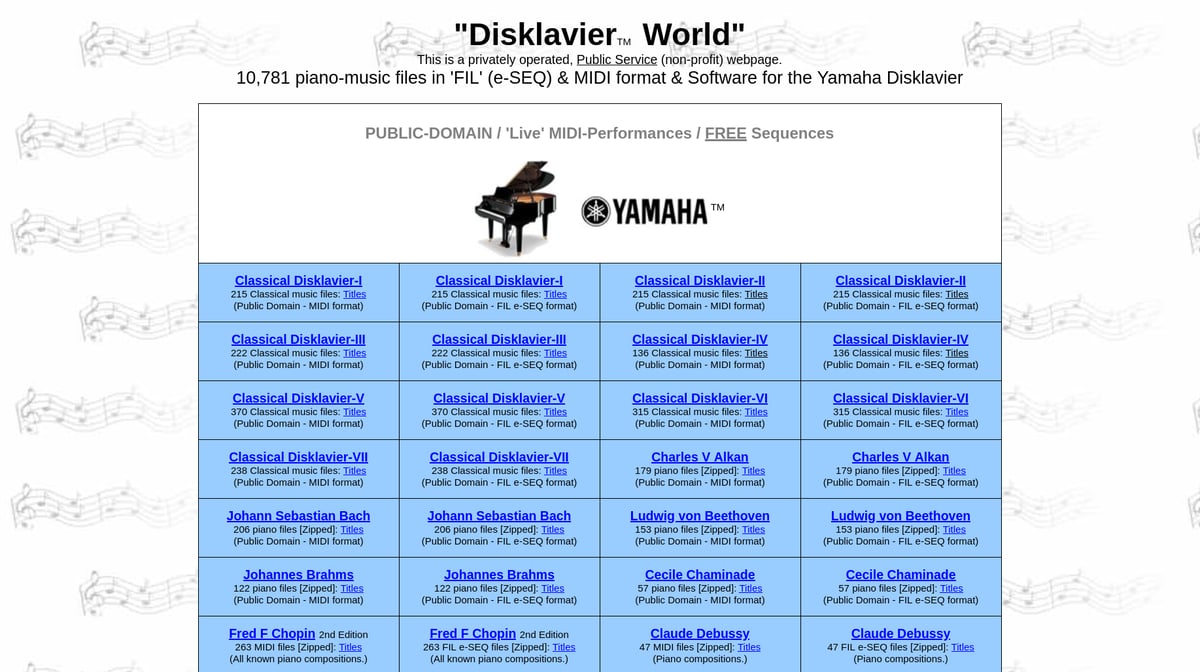
The Kuhmann Directory (also widely known as Disklavier World) was one of the biggest free online libraries of Yamaha Disklavier-ready music files. It’s no longer available at its original home on kuhmann.com, so I maintain a working mirror of the library. I’ve written this page to answer the questions I hear most often: What was it? Is it still online? Which files do I need (MIDI vs E‑SEQ)? How do I load them onto my Disklavier?
I now have a full, accessible copy of the Kuhmann Directory here. You can navigate and search the entire directory structure online.
Download the Kuhmann Directory (MIDI)
Download the Kuhmann Directory (E‑SEQ)
Please note that I’m not affiliated with the original Disklavier World / Kuhmann website. Please only download and use files you have the legal right to use. If you’re a rights holder and believe something here infringes your copyright, see my DMCA Policy.
If you put the entire Kuhmann Directory on a USB stick (folders and all), it will load correctly on a Mark IV or an E3 system (DKC-800 / DKC-850). However, the ENSPIRE appears to misbehave once there are more than a few thousand songs on a single USB stick. Several readers have experimented with this, and the practical limit seems to be around 5,000 songs. I recommend splitting the Kuhmann Directory across at least two USB sticks.
These MIDI files have been altered from their original form. Title tracks have been generated by AI, and extra title and text fields removed. This is so they’ll be more compatible with Disklaviers, and to prevent blank and nonsense titles.
What was the Kuhmann Directory (Disklavier World)?
Disklavier World was a privately operated, public-service style website created and maintained by Robert C. Kuhmann. Disklavier owners loved it for its huge selection and Disklavier-friendly formatting. In the player-piano world it became a go-to place to find Disklavier-compatible music in two key formats:
MIDI (.MID) files. These were typically already prepared in SMF Type 0, which is friendlier for most hardware player systems.
E‑SEQ (.FIL) files. These are compatible with earlier floppy-based Disklaviers and Yamaha player systems. Kuhmann had one of the largest directories of E-SEQ files on the internet.
The library included a mix of “live” performances, piano-roll conversions, and hand-sequenced performances in many genres. Depending on how you count (songs vs. individual files across multiple formats), the collection includes thousands of pieces.
Is kuhmann.com / Disklavier World still online?
No. The original kuhmann.com Disklavier World page is now offline. Like many older “one-person” reference sites, it eventually disappeared from the active internet. There are snapshots floating around (for example via the Wayback Machine), but a snapshot isn’t always the easiest way to actually use the files on a real instrument.
That’s why I keep a maintained mirror of the collection:
Kuhmann Directory (MIDI / Type 0)—my mirror download
Kuhmann Directory (E‑SEQ / .FIL)—my mirror download
What’s in my mirror (and why it’s useful)
I saved a copy of the Kuhmann library before it vanished, and I host it so Disklavier owners can keep using it. In addition to simply re-hosting the files, my copies may include minor fixes and updates for practical playback and organization.
What you’ll find inside
MIDI (.MID) files intended for Disklavier playback (many are already Type 0 / single-track)
E‑SEQ (.FIL) files for early Disklaviers and Yamaha player systems that can’t read MIDI natively
If you’re new to downloading music for a Disklavier, you’ll also want these related pages:
Free Yamaha Disklavier MIDI Files (and E‑SEQ): Best Download Sources. This article includes other sources, aside from the Kuhmann Directory.
Premium Yamaha Disklavier MIDI Files (and E‑SEQ): Best Download Sources. This article includes a variety of larger, paid sources of music for the Disklavier.
Disklavier Compatibility Table: Which Models Play MIDI or E‑SEQ? You can look up your model and determine whether you can play MIDI files or E-SEQ files.
MIDI vs. E‑SEQ: which one does your Disklavier need?
This is the #1 reason people get stuck. Not every Disklavier plays the same file types, especially when you’re dealing with older floppy-based systems.
If you’re unsure, don’t guess: You can use my Disklavier Compatibility Table to confirm what your controller actually supports.
If you specifically need help with E‑SEQ workflows (including PIANODIR.FIL), start here:
Converting MIDI Files and Creating PIANODIR.FIL for E‑SEQ Files. The Kuhmann Directory already has E-SEQ files. However, this article explains how to convert MIDI files to E-SEQ, should you need to.
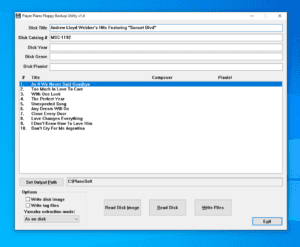
Using PPFBU to Back Up Disks: Disklavier Floppy Disks, E‑SEQ, and MIDI Formats. This article explains how to extract E-SEQ files and MIDI files from your own floppy disks, including Yamaha PianoSoft disks.
How to download and play the files
Step-by-step (most people)
- Identify your Disklavier/controller. Use the compatibility table to confirm which formats it plays (E‑SEQ vs. MIDI, and whether Type 0 matters).
- Download the correct archive: MIDI or E‑SEQ.
Kuhmann Directory (MIDI / Type 0)
Kuhmann Directory (E‑SEQ / .FIL) - Unzip on a computer (Windows/Mac/Linux is fine).
- Load to your playback media (floppy disk, USB, floppy emulator, Nalbantov, etc.).
- Test a few files before you invest time organizing a giant library.
For floppy-era Disklaviers (Mark I / Mark II and similar)
If your system is E‑SEQ-based, you may need extra steps such as proper 8.3 filenames, uppercase naming, and sometimes a PIANODIR.FIL index. The files in the Kuhmann Directory all have proper 8.3 filenames, but you’ll still need to generate PIANODIR.FIL indices. I cover the full process (and common pitfalls) in the below guide:
Converting MIDI Files and Creating PIANODIR.FIL for E‑SEQ Files. This article explains how to create a PIANODIR.FIL for a collection of E-SEQ files, and includes a video.
Common problems (and easy fixes)
“It only plays one hand” (or it plays strangely)
This is usually a MIDI Type 1 vs. Type 0 problem. Many player systems interpret Type 0 more reliably. You’ll find nearly all the MIDI files in the Kuhmann Directory work just fine, but not all of them are converted to Type 0, so I include this just in case. You can use my free converter tool here: MIDI Type Conversion Tool: Convert Type 1 to Type 0.
“My Disklavier can’t see the E‑SEQ files”
Most of these early Disklavier require a PIANODIR.FIL index and strict file naming rules. Start with this guide. E‑SEQ and PIANODIR.FIL guide (Mark I / Mark II).
Need hands-on help?
If you’re in Maine and want help getting your Disklavier set up for reliable playback (USB, Nalbantov, PianoStream, file preparation, etc.), you can reach me here: Contact Alex.
Copyright and licensing notes
Player-piano file libraries can get legally complicated quickly. Even if a composition is public domain, a specific performance, arrangement, or encoding may not be.
Use files only in ways you have the rights to use them (personal practice/playback is different from redistribution or commercial use).
If you’re a rights holder and believe material hosted here infringes your copyright, please use my DMCA takedown process.
I do not claim ownership of third-party compositions or trademarks.
More Disklavier music sources (free + paid)
The Kuhmann Directory is a classic resource, but it’s not the only good option. Here are my curated lists:
Free Yamaha Disklavier MIDI Files (and E‑SEQ): Best Download Sources
Premium Yamaha Disklavier MIDI Files (and E‑SEQ): Best Download Sources
FAQ
Is the Kuhmann Directory (Disklavier World) still online?
The original kuhmann.com Disklavier World page appears to be offline, and has been for several years. I keep a mirror so the library remains usable as a practical download for Disklavier owners.
Which download should I choose: MIDI or E‑SEQ?
If you have a newer Disklavier/controller, pick MIDI. If you have an early floppy-based Disklavier that can’t read MIDI natively, select E‑SEQ (.FIL). And if you’re not sure, use my Disklavier Compatibility Table.
What is “MIDI Type 0” and why does it matter?
MIDI Type 0 stores the song as a single track. Many hardware player systems interpret Type 0 more reliably. If a file plays “only one hand,” convert it using my free tool: MIDI Type 1 to Type 0 Converter.
Do I need a PIANODIR.FIL file?
Most early Disklaviers require it, although later systems don’t. It’s good practice to always include one. If your Disklavier can’t “see” files that are present, start here: E‑SEQ + PIANODIR.FIL guide.
Where can I find more Disklavier music?
I maintain curated lists of both free and paid sources, plus notes about which sites tend to work best with Disklaviers: Free sources and premium sources.
References
Mechanical Music Digest (2010): note describing Robert Kuhmann’s Disklavier music files resource (MIDI and e‑SEQ).
Internet Archive: description referencing “Disklavier World” as a privately operated public-service library of e‑SEQ and MIDI files.
Disklavier World Blogspot: pages describing the Disklavier World library and file formats (e‑SEQ / MIDI) and general organization notes.