If you’ve ever heard a piano note go “wah‑wah‑wah,” you’ve heard string beating. For piano tuners, it’s one of the most useful sounds: It tells you, instantly, whether two strings are truly matching or fighting each other.
In this article I’ll explain what beating between strings is, why piano string beating is so obvious in unisons, and how to listen for beat rate in a way that makes sense (even if you don’t read music or think in numbers). There’s also an interactive demo below so you can hear the effect for yourself.
Live demo of beating between strings
This interactive tool lets you tune three “strings” around A440 and hear the beat rate as you move them sharp or flat. Start with “In tune,” then switch to “Slightly off” and “Badly off” and listen to how the beating speeds up.
Listening tip: slow beats (around 0.5–2 per second) are easy to count. Fast beats can blur into a rougher, buzzy sound. Both are forms of beating—just different speeds.
What is string beating?
String beating happens when two sounds are very close in pitch, but not identical.1 Your ear (and the air in the room) hears the two waves alternately reinforcing and canceling each other out. The result is a gentle pulsing of loudness—often described as a “wah‑wah” or “wobble.” Some customers refer to this sound as a “vibration,” or they might even call it “tinny.” The generic, all-encompassing term is “honky-tonk”!
On a piano, beating shows up all the time because many notes use two or three strings tuned to the same pitch.4 Multiple strings per note increase power, sustain, and richness, but when those strings aren’t perfectly aligned, you get unison beating.
Beating is a simple, practical cue you can train your ear to recognize and control. Piano technicians use it constantly because it’s one of the clearest ways to judge whether strings are truly in tune with one another.
The quick math
If two strings are beating, there’s a quick way to determine the rate of beating: Simply subtract the frequency of one string from the other.3 The magnitude of that value is the rate of beating.
For example, if one string is at 440 Hz and another is at 441 Hz, the beating at a rate of about 1 Hz, or one beat per second. If they’re 440 Hz and 442 Hz, you’ll hear about 2 beats per second. (On a real piano you also have overtones and inharmonicity, so the picture is richer—but this gets you oriented.)
Why piano string beating matters (especially in unisons)
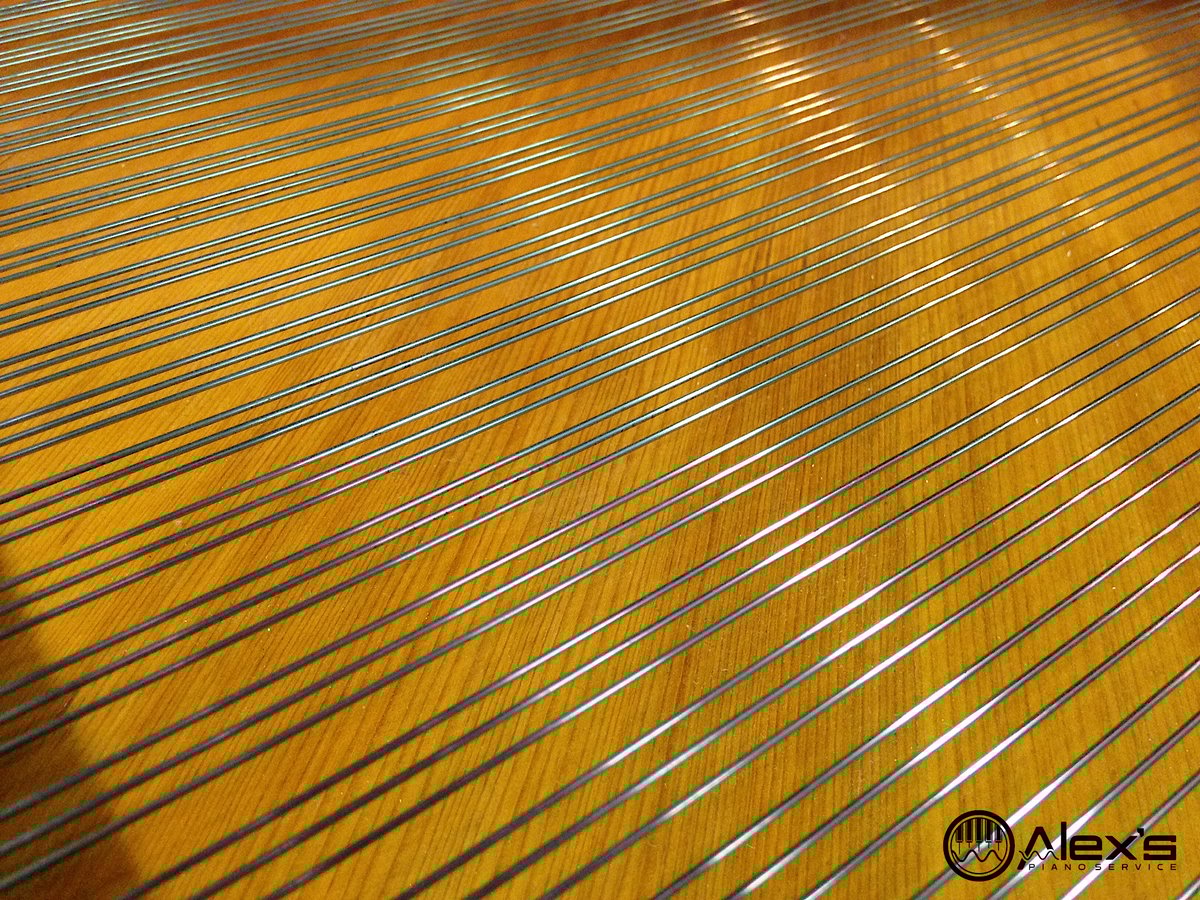
Most of the piano keyboard isn’t “one note = one string.” In the middle and upper ranges, each note usually has three strings tuned to the same pitch. That design gives you more power and a richer tone—but it also means you can’t just tune “the note.” You have to tune the relationship between strings.
When a unison is clean, the sound is focused and stable. When it’s off, you’ll hear piano string beating as a shimmer, a pulse, or a swirl on the sustain—even if the pitch is “close.”
Clean unison: The note sounds stable. People often refer to this sound as “pure,” or like “bells.” It can also be slightly louder.
Slightly off unison: The note has a low “wah‑wah” beating. If many notes are like this, the piano will sound distinctly out-of-tune to a pianist.
Badly off unison: Much faster beating; the note sounds unfocused, edgy, or “out” even to non‑musicians. If many notes are like this, the piano will sound “honky-tonk” or like a “saloon” piano.
That’s why beating is such a useful tuning cue. It’s not subtle at all once you know what to listen for.
Beating isn’t always “bad”
Here’s an important nuance. In unisons, we generally want to remove beating as much as possible. But in temperament tuning (the way the scale is laid out across the keyboard), many intervals intentionally have beat rates.5 Those beats are part of how equal temperament is created and checked by ear.
So the goal isn’t “no beats anywhere.” The goal is for unisons to have minimal beating, and for intervals to have controlled beating at expected rates.
How to hear beat rate (without getting lost)
If you want to train your ear, don’t start by chasing tiny differences. Start with beats you can plainly hear, then work toward slower beats.
A simple listening exercise
- Play a steady tone (or use the demo above).
- Make one string slightly sharp or flat until you hear a clear pulse.
- Count the pulses for 5 seconds and multiply by 12 to estimate beats per minute—or just count “beats per second” directly.
- Move the pitch closer and notice the beat rate slow down.
- Move it farther away and notice the beat rate speed up.
This is the core skill behind hearing unison beating on a piano: you’re listening for that pulse and learning to slow it down until it disappears into a stable tone.
What beating sounds like on a real piano
On real strings you’ll often hear beating most clearly in the sustain. Depending on the note and the instrument, it might present as a slow “wah‑wah” swell, a shimmer that seems to drift, a roughness or “chorus” effect (especially when it’s faster), or a sense that the note won’t “sit still.”
The cleaner the unison, the more the note feels like a single, confident sound.
Common causes of piano string beating
When people say “this note sounds out,” there are a few different realities hiding under the same complaint. Here are the most common causes I see behind audible beating between piano strings:
The unison is simply out of tune
This is the straightforward one. Two (or three) strings for the same note are slightly mismatched in pitch. You’ll hear beating, and the tone won’t feel centered.
Unstable partials or “false beats”
Sometimes a string produces a waver or pulse even when it’s not actually close to another string’s pitch.2 This can be caused by things like string condition, seating, coupling issues, or uneven behavior in the string’s overtones. In practice, it can make a unison feel stubborn—like it won’t settle cleanly.
False beats are one reason a piano might sound “wobbly” even right after tuning, especially in specific notes or ranges.
What you’re hearing is temperament (intentional beating)
In certain intervals, beating is expected and used as a guide. If you’re listening to a third, sixth, or other interval and hearing beats, that isn’t automatically a problem. The question is whether the beat rate is consistent with the tuning style and the instrument’s scale.
FAQ: string beating and piano tuning
What does string beating sound like?
Most people describe it as a “wah‑wah,” a wobble, a pulse, or a shimmer in the sustain. It might sound “honky-tonk.” The closer the pitches are, the slower and more obvious the pulse. The farther apart they are (but still close), the pulse speeds up and can sound rougher.
Is beating the same thing as vibrato?
No. Vibrato is an intentional modulation of pitch (usually by a performer). Beating is what happens when two steady pitches interact. The pulsing is created by interference between tones, not by one pitch bending up and down.
Why do piano notes have three strings?
Multiple strings per note increase power, sustain, and richness. The tradeoff is that those strings need to be matched closely—or you’ll hear unison beating.
Can you eliminate all beating on a piano?
You can dramatically reduce beating in unisons, and that’s typically the goal. But many musical intervals in temperament will still have beat rates by design, and some pianos also exhibit false beats in certain strings or ranges.
How can I measure beat rate?
You can measure it by counting pulses per second (or per 10 seconds) when the beating is slow enough to count. The demo above also displays beat rate as a number, which is a great way to connect the sound you’re hearing with an actual rate.
Citations
1. Berg, Richard E. “Beats.” Sound, Encyclopaedia Britannica, 2 Jan. 2026,
https://www.britannica.com/science/sound-physics/Beats. Accessed 17 Jan. 2026.
2. Capleton, Brian. “False Beats in Coupled Piano String Unisons.” The Journal of the Acoustical
Society of America, vol. 115, no. 2, Feb. 2004, pp. 885–892. doi:10.1121/1.1636461.
3. Moebs, William, et al. “17.6 Beats.” University Physics Volume 1, OpenStax, 19 Sept. 2016,
https://openstax.org/books/university-physics-volume-1/pages/17-6-beats. Accessed 17 Jan. 2026.
4. “Piano.” Students | Britannica Kids | Homework Help, Encyclopaedia Britannica, Inc.,
https://kids.britannica.com/students/article/piano/390914. Accessed 17 Jan. 2026.
5. Temperley, Nicholas. “Tuning and Temperament.” Encyclopaedia Britannica, 8 Jan. 2025,
https://www.britannica.com/art/tuning-and-temperament. Accessed 17 Jan. 2026.
6. The Editors of Encyclopaedia Britannica. “Equal Temperament.” Encyclopaedia Britannica, 30 May 2019,
https://www.britannica.com/art/equal-temperament. Accessed 17 Jan. 2026.