This post is a “deep dive” article branching from my Buying Cheap Digitals guide—although the top few in this category aren’t quite inexpensive instruments anymore! If you’re still deciding between brands (or between a slab piano and a furniture console), start with that overview first.
I get asked this constantly: “If I buy the cheapest Roland FP, will I regret it?” Or: “Is the FP-90X really that much better?” What’s the cheapest instrument that’s good enough?
The short version: Roland’s FP-X line is a real hierarchy—but not always in the way people assume. Some upgrades are “practice-changing,” and others are basically convenience/features.
Quick picks (just tell me what to buy)
- Absolute tightest budget: FP-10. Same core action family as the FP-30X/60X. You’re mainly giving up connectivity and speaker power.
- Best “all-around” value for most beginners/intermediates: FP-30X. Proper line outs, Bluetooth Audio, more polyphony/tones, and still portable.
- You want “home piano ergonomics” without going full console: FP-60X. Screen, dedicated controls, bigger speaker system, mic input, and generally less “button-combo gymnastics.”
- You care about the keyboard feel and flagship sound the most: FP-90X. This is the only one here with the PHA-50 action and Roland’s modeling engine.
Important reality check: FP-10, FP-30X, and FP-60X are all built around the same PHA-4 Standard action. Yes, their least expensive keyboard already had a good, mid-range action. This is, in my opinion, the most remarkable detail of the Roland lineup. If your upgrade goal is “better key feel,” the jump that actually changes the action is FP-90X.
What actually changes as you climb the FP ladder
When people say “the higher model is better,” they’re usually mixing together four different things:
- Action feel (how the keys respond under your fingers)
- Piano engine (how the instrument generates the piano sound)
- Speaker system (how convincing it sounds in the room without headphones)
- Connectivity + controls (line outs, USB audio, Bluetooth audio, screen, real knobs/sliders)
The “gotcha” in the FP range is that those four things don’t all improve at the same time. You can spend more and get a much better speaker system and controls… while the key action stays basically the same.
At-a-glance comparison (the parts that matter)
| Model | Action | Piano engine | Polyphony | Speaker power | Real line outs? | USB Audio? | Mic input? | Weight (approx.) |
|---|---|---|---|---|---|---|---|---|
| FP-10 | PHA-4 Standard | SuperNATURAL Piano | 96 | 6W x2 | No (headphone out only) | No (USB MIDI only) | No | 12.6 kg |
| FP-30X | PHA-4 Standard | SuperNATURAL Piano | 256 | 11W x2 | Yes (L/Mono, R) | Yes | No | 14.8 kg |
| FP-60X | PHA-4 Standard | SuperNATURAL Piano | 256 | 13W x2 | Yes (L/Mono, R) | Yes | Yes | 19.3 kg |
| FP-90X | PHA-50 hybrid wood/plastic | Pure Acoustic Piano Modeling | Piano: “limitless” (select tones), Other: 256 | 25W x2 + 5W x2 | Yes (L/Mono, R) | Yes | Yes | 23.6 kg |
Note that Bluetooth features can vary by region/country. If Bluetooth is a “must-have,” confirm the exact model/region you’re buying before you commit.
Roland FP-10: the “cheap” one that isn’t junk
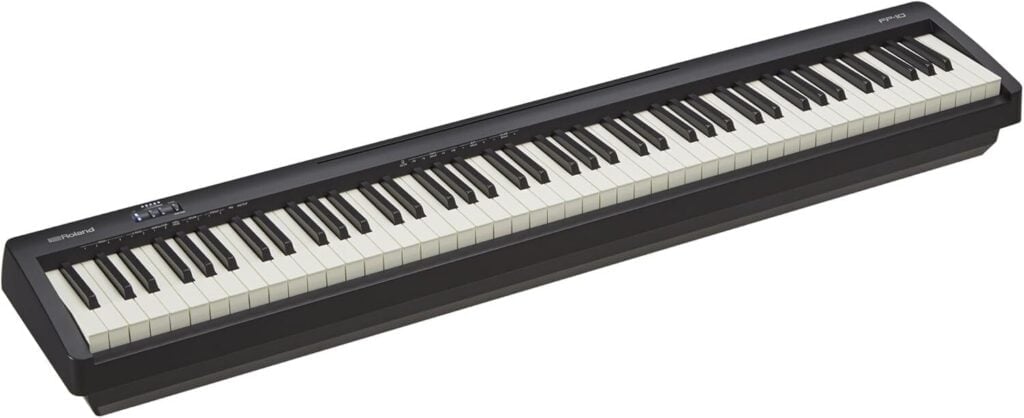
The FP-10 is the bottom of the FP-X line, but it’s not the usual “starter keyboard trap.” You get a real 88-key weighted action and a legit piano engine. And to reiterate once more, that means Roland’s most inexpensive keyboard already has one of the better actions available! The compromises are mostly about outputs, speakers, and convenience.
Who it’s for
- You’re a beginner and you want a real weighted action on the lowest budget.
- You’re mostly a headphones player, in which case speakers aren’t too relevant.
- You’re okay keeping your setup simple (one output, minimal controls).
What to watch out for
- Outputs: you’re basically using the headphone jack as your “line out.” That’s fine at home, but it’s not ideal for stage/mixers/interfaces.
- Speakers: totally usable, but this is the smallest speaker system in the group.
- Feature access: fewer direct controls; you’ll lean on the app more.
If money is tight, the FP-10 is a serious contender. Spend the “saved” money on a stable stand, a decent bench, and a better pedal.
Roland FP-30X: the real “sweet spot” upgrade
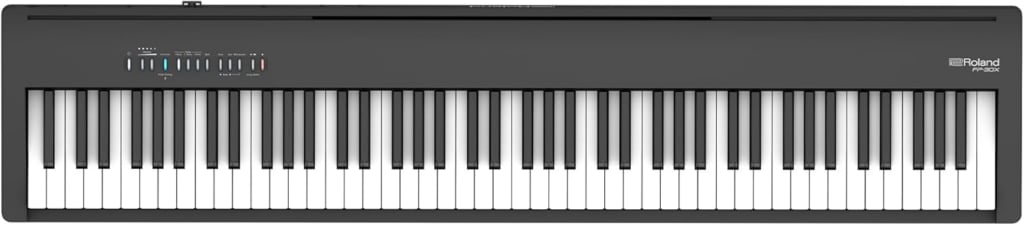
The FP-30X is where the line starts feeling like a more serious instrument, capable in more situations. You still have the same action family as the FP-10, but you gain a lot of quality-of-life upgrades. The FP-30X has stronger speakers, far more polyphony/tones, Bluetooth Audio, and proper outputs.
Why people end up happiest here
- Better connectivity: real line outs and USB audio make it easier to record, stream, or play out.
- Bluetooth Audio: play-along tracks through the piano speakers/headphones (huge for lessons).
- More “future-proof”: more polyphony and tones means you’re less likely to outgrow it quickly.
What it still doesn’t solve
- Still no real screen and a lot of functions rely on button/key combos.
- Action feel isn’t an upgrade over FP-10. It’s the same keybed.
If you can afford the FP-30X without skipping essentials (bench/stand/pedal), it’s usually the safest “no regrets” choice.
Roland FP-60X: the “home setup” slab
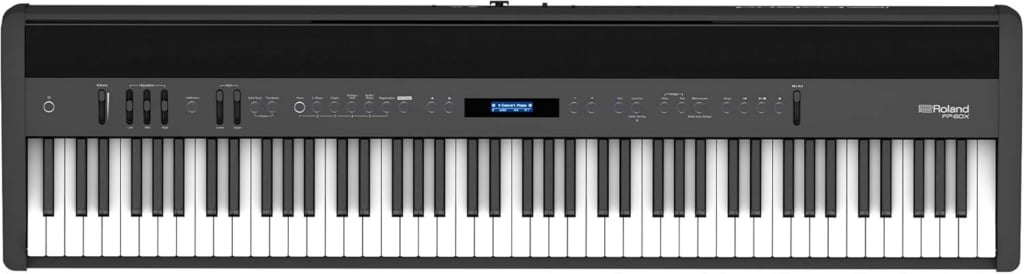
The FP-60X is where Roland starts assuming you want an instrument that can live in your house like a semi-permanent piano, without the full furniture console form factor. You get a screen, more direct controls, better built-in ambience options, and a more powerful speaker system.
Best reasons to pay for the FP-60X
- Better “day-to-day” experience: screen + dedicated controls = less menu/button-combo frustration.
- More speaker authority: if you’re not always on headphones, this matters.
- Mic input + vocal effects: useful for sing-and-play or simple live use.
- More “piano-like setup options”: it pairs nicely with the more substantial stand/3-pedal ecosystem.
Reasons you might skip it
- You’re upgrading for key feel: the FP-60X still uses the PHA-4 Standard action. Yes, the same action as the FP-10!
- You’re always on headphones + always using a VST: you may not benefit from the nicer onboard UI/speakers as much.
My “FP-60X in one sentence” summary: If you want a slab piano that behaves like a home instrument (controls + sound in the room), the FP-60X makes a lot of sense.
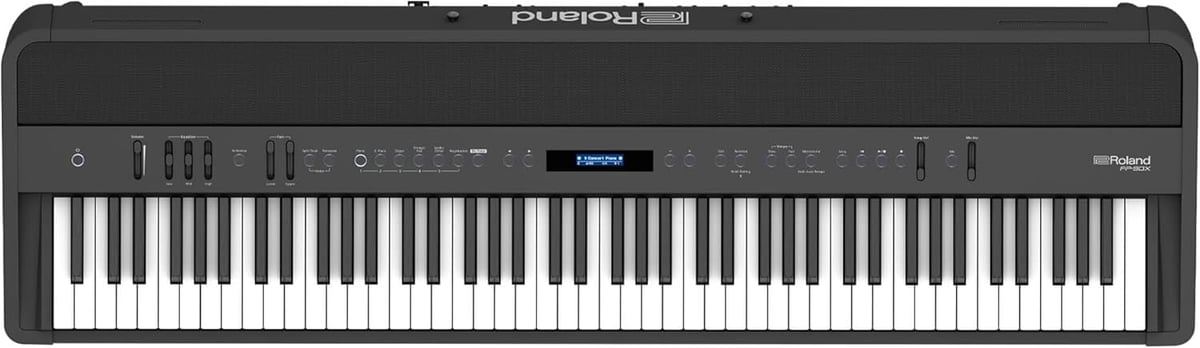
Roland FP-90X: the flagship (and the only real “feel” upgrade)
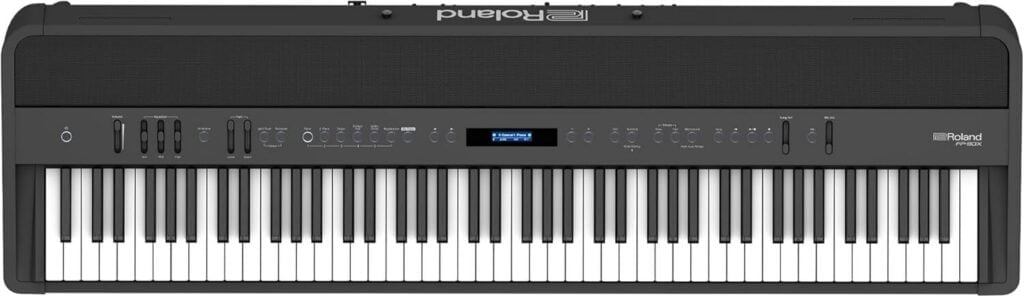
The FP-90X is the “top of the slab” in this family. Two major things happen here:
- You get the PHA-50 key action (hybrid wood/plastic). This is the step that actually feels like a different instrument.
- You get Roland’s Pure Acoustic Piano Modeling, plus the biggest speaker system in the lineup.
Who should buy it
- You’re action-sensitive—you want the most real piano experience—and you don’t want to feel like you bought a “starter” keybed.
- You want the most convincing onboard piano sound + response you can get in a portable format.
- You’re going to play on the built-in speakers regularly and want them to actually fill a room.
Who probably shouldn’t
- You’re a true beginner on a tight budget. The FP-30X will usually get you further, faster, if the extra money would otherwise delay lessons or accessories.
- You need lightweight. The FP-90X is still portable, but it’s a noticeably bigger carry than the FP-10/30X. The FP-10 is a very compact, lightweight instrument, but the FP-90X is tough to carry on your own.
If you’re the kind of player who immediately notices (and cares) when an action feels “off,” the FP-90X is the one that makes sense long-term.
What you’re paying for (model-to-model)
FP-10 → FP-30X
- Worth it if: you want Bluetooth Audio, real line outs, USB audio recording, more polyphony/tones, and a more flexible “do everything” piano.
- Not worth it if: you literally only need a weighted practice action on headphones and you’re keeping the setup minimal.
FP-30X → FP-60X
- Worth it if: you want a screen, real-time controls, mic input, and stronger speaker performance in the room.
- Not worth it if: you expected a major action/feel improvement (it’s still the same PHA-4 Standard family).
FP-60X → FP-90X
- Worth it if: action feel + flagship sound generation are the entire point of your upgrade.
- Not worth it if: you’re mostly using a computer/VST and don’t care about onboard speakers/sound engine.
Accessories that actually matter
If you’re trying to get the most “real piano” experience out of any of these, accessories matter more than people think.
- Pedal: a continuous damper pedal (or a proper 3-pedal unit) changes how you learn pedaling. FP-60X/90X ship with the DP-10 style continuous pedal; FP-10/30X include a basic switch pedal.
- Stand stability: a wobbly stand makes everything feel worse. If you can, use the matching stand + pedal board system for your model.
- Bench height: don’t ignore this. Bad bench height = bad technique habits.
If you’re troubleshooting weird behavior (dead keys, “stuck sustain,” intermittent power, noisy jacks, etc.), see my Digital Piano / Keyboard FAQ.
Forum notes: what real owners argue about online
I don’t treat forums as “truth,” but they’re great for spotting patterns: what people notice, what annoys them after the honeymoon period, and what features actually get used. Here are some recurring themes I see around the FP-X line:
FP-10 vs. FP-30X: “Is the 30X worth it if I’m using a VST?”
In Pianoteq/VST circles, owners bring up practical differences like USB audio and proper line outs on the FP-30X that the FP-10 doesn’t really have in the same way.
There’s also discussion about sustain pedal behavior and how some setups work around it with external MIDI expression devices.
Thread: https://forum.modartt.com/viewtopic.php?id=11519
FP-30X action feel: “Roland is heavy / sluggish” (clicking/clacking)
A lot of players describe Roland’s midrange action as heavier than comparable Yamaha/Casio actions. Others love it because it feels closer to an acoustic to them.
Some owners also report key noise (clicking/clacking) and debate how common it is vs. bad luck on a specific unit.
My take is that the FP-10/FP-30X/FP-60X still offer the most realistic touch in their price ranges, but that Yamaha has an edge on mechanical design quality—Yamaha products last longer with fewer nuisances.
Thread: https://www.reddit.com/r/piano/comments/1arrerk/trying_to_decide_between_roland_fp30x_fp60x_and/
FP-30X vs. FP-60X: “The 60X is the one that feels like a real instrument”
One common theme: the FP-60X’s screen + dedicated controls are “night and day” compared to the FP-30X’s key-combo approach.
People justify the price jump with “more powerful speakers + much bigger sound set + better UI.”
https://talks.pianodreamers.com/topic/roland-fp60x-discussions/
Used-market: “FP-10 and FP-30X aren’t that different… so buy used”
On gigging/keyboard forums, you’ll see the argument that the lower-tier Rolands are close enough in core sound/feel that the best move is often buying used and putting money into speakers/pedals.
Thread: https://forums.musicplayer.com/topic/187679-roland-fp-103030x-bang-for-the-buck-on-used-market/
FP-60X vs. FP-90 (and by extension 90X): “Do ‘improvements’ matter?”
Some players downplay generational/action changes and argue “if the action works for you, it works,” while others are very sensitive to feel and response.
Thread: https://www.reddit.com/r/Roland/comments/tmd6d5/roland_fp60x_vs_roland_fp90/
FAQ
If I’m a beginner, will I outgrow the FP-10?
Possibly—but most people don’t outgrow it because of the key action. They outgrow it because they want better pedals, better outputs, better built-in speakers, or easier controls. If you’re disciplined about practice, the FP-10 can take you surprisingly far.
If I mostly use headphones, does the FP-60X/90X still matter?
The speaker upgrades matter less on headphones, but the controls (screen, sliders, mic features) and the FP-90X’s action/modeling can still matter a lot—especially if you’re picky about feel and sound response.
Can these act as controllers for VSTs (Pianoteq, Keyscape, etc.)?
Yes. The main differences are in workflow: models with USB audio, real line outs, and better connectivity make recording/streaming and general computer integration easier. If your entire world is VSTs, prioritize connectivity over onboard tones.
Bottom line
If you want the most “piano per dollar,” the FP-30X is usually the move. If you want the most “piano-like experience” in this lineup without going to a console/hybrid, the FP-90X is the one that actually changes the feel and the core engine. And if you’re on a tight budget, the FP-10 is still a legitimate instrument—just know what you’re giving up (mostly outputs/speakers/convenience).
If you have a specific use case (apartment practice, gigging, VST-only studio, teacher/student setup), contact me and tell me what you’re trying to do. The “right” FP model is mostly about the situation, not the spec sheet.