Quick answer: Ideal humidity for a piano
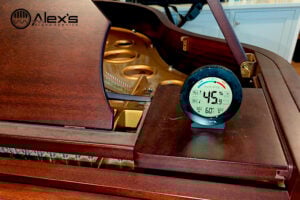
If you want the simplest target that keeps most pianos stable year-round, aim for about 42–45% relative humidity (RH) and focus on consistency. Start by purchasing a hygrometer so you can measure humidity.
- Best target: ~42–45% RH.
This is my ideal range. - Very good range: 40–50% RH.
This wider range is still very safe. - Generally safe manufacturer-style range: 40–60% RH.
Make sure to avoid rapid changes, even within this range. - Most important rule: avoid rapid swings.
Stable humidity helps keep pianos in tune and healthy.
If your readings are out of range
- Below ~35–40% RH for days: Add humidity to the room with a humidifier. Also consider a piano humidity-control system such as the Dampp-Chaser Piano Life Saver System.
- Above ~50–60% RH for days: Remove humidity from the room using a dehumidifier or HVAC adjustments. Check for moisture sources. Consider a Dampp-Chaser Piano Life Saver System, or their dehumidifier only option.
- Unsure your hygrometer is accurate? Calibrate it first. Errors can send you chasing the wrong solution. Make sure you have a good quality hygrometer.
Pianos are creatures of humidity. I’m constantly talking to my customers about humidity, and it’s one of the biggest factors in tuning, regulation, and piano lifespan. It’s difficult to overstate the importance.
Because the piano is largely wood, changes in relative humidity change wood moisture content, which changes dimensions and therefore regulation/tuning stability.
Here in Maine, we see dry indoor air in the winter, sticky summers, and plenty of older houses that don’t make life easy for instruments. When I’m discussing humidity with a customer, I’m usually asking three questions:
- Do we know the humidity in the piano room, and how much it varies?
- Can we control the humidity in the piano room?
- Do we need to further protect the piano with a Dampp-Chaser?
The sections below follow that same order, with links out to the full articles.
Why does relative humidity matter?
A piano goes out of tune because it’s made primarily of wood, and wood is hygroscopic, meaning it exchanges humidity with the air. Relative humidity (RH) is the amount of moisture in the air compared to what the air could hold at that temperature. As relative humidity rises or falls, the wood in your piano will slowly trade moisture with the air until it reaches a new equilibrium moisture content. When that moisture content changes, the wood swells a bit in humid air and shrinks a bit in dry air—even if the room temperature feels perfectly comfortable.
The biggest tuning swing comes from the soundboard. It’s built with a slight arch (“crown”), and the bridges sit on top of it. When the soundboard absorbs moisture, that crown increases and pushes the bridge harder into the strings, stretching them slightly and making the pitch rise (sharp). When the air dries out, the soundboard shrinks, the crown relaxes, the pressure against the strings drops, and the piano goes flat.
This change is often most noticeable between the bass and treble sections. The bass bridge is typically nearer the edge of the soundboard, and the treble is nearer the middle. The middle of the soundboard changes the most.
The ideal humidity for a piano room
My recommendation for ideal humidity for a piano room is between 42% and 45%. I choose this range for a few reasons. Piano manufacturers typically set their lower limits no lower than 30%—and usually higher. EPA and health guidance standards typically recommend staying below 50%. See specific manufacturer recommendations and other sources below.
Stability matters as much as the exact number; rapid swings can cause tuning instability and even damage. Pianos last the longest and sound the best in environments with stable humidity.
Start by measuring the humidity
In short: If you don’t already have a hygrometer you trust, that’s the place to start. My recommendation is to aim for 42-45% relative humidity, and minimal variation.
My observation is that furnace humidistats, cheap digital weather stations, and the humidity readout on a portable humidifier are typically “optimistic.” This is echoed by most technicians who carry their own high-quality hygrometers. And regardless, it’s better to have a hygrometer located near the piano.
I keep an up-to-date guide on the best hygrometers for pianos and why cheap ones can put your piano at risk. That article covers the specific models I like. It also shows how to place them on or near the instrument, and the humidity ranges I’m aiming for in most homes.
In most homes, I aim for a relative humidity of 42–45%. This is similar to the Piano Technicians Guild (PTG), which recommends 42%. I include a detailed breakdown by manufacturer below, and additional citations.
If you find the humidity is falling too low or traveling too high, the situation likely merits intervention. The 50% upper limit comes from the EPA, based on the risk of mold and mildew developing in homes. Some piano manufacturers list wider tolerances, but in homes we still aim to stay under ~50% to reduce mold and corrosion risk.
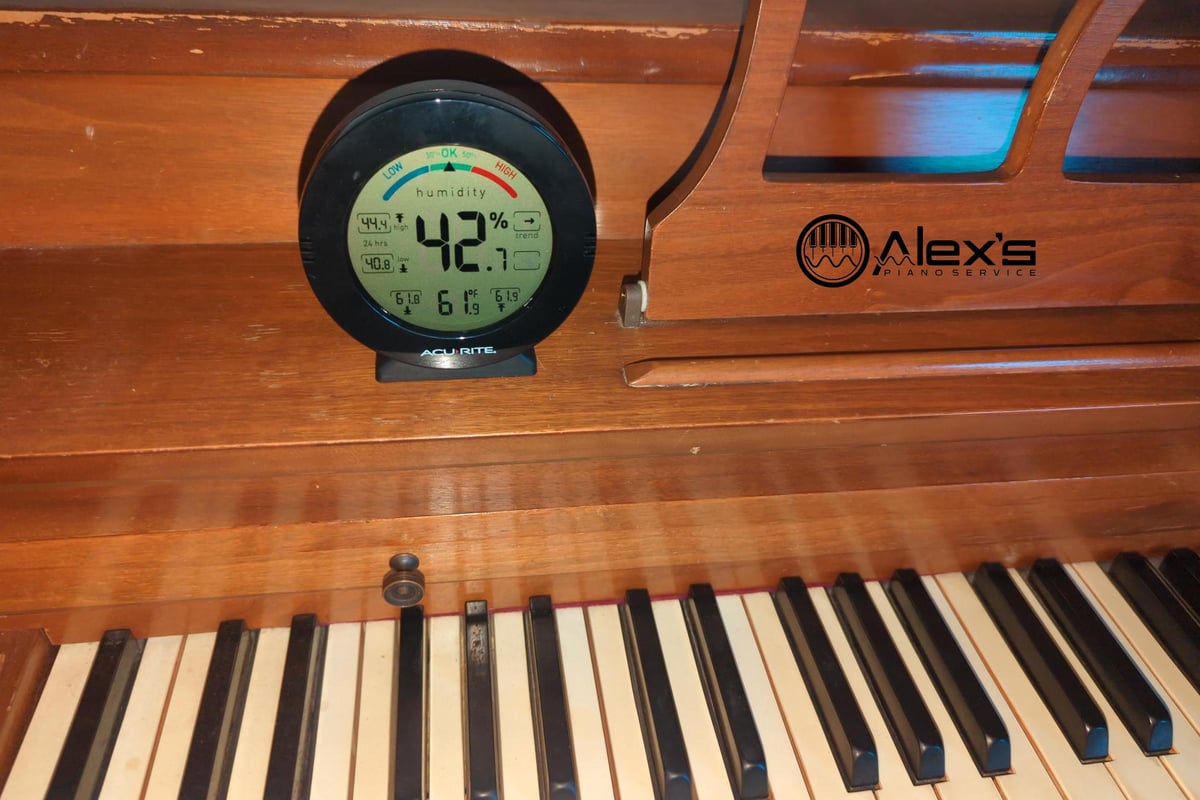
Positioning the hygrometer
The hygrometer should be located near the piano at key height, not on a drafty windowsill, floor, or against an exterior wall. The best place, normally, will be right on the music rack. The AcuRite mentioned here can even be magnetically attached to the plate in a grand piano, or placed on top of an upright piano. Other acceptable positions include the cheek blocks or the top of the instrument. Humidity can vary within a room, or even at different distances from the floor.
Calibrating the hygrometer
The simplest method is to use a 75% “salt pack” calibration kit, such as the Boveda One-Step Hygrometer Calibration Kit. Put the hygrometer in the kit bag and seal it. The AcuRite 01080M Pro will fit in the bag, but just barely, and only without the base. It works easily with the Oasis or smaller hygrometers.
- Leave it at least 24 hours at room temperature. (Boveda recommends 65–75 °F / 19.5–23.5 °C.)
- After 24 hours, it should read 75% RH. Note the difference as your offset from proper calibration.
Once you’re confident the number is stable, calibrate the hygrometer. This is usually quite easy. For instance, here is the process for the AcuRite 01080M:
- Enter calibration mode by pressing & holding the ▲ and ▼ buttons together for at least 5 seconds.
- Adjust the displayed value up/down with ▲/▼ until it matches your known reference (e.g., 75%).
- Press “RECORDS” to save and move to the next item, which is room temperature. Adjust this as well if you have a more accurate temperature sensor available; otherwise, leave it alone.
- Stop pressing buttons; after 12–15 seconds it saves and exits automatically.
Most manufacturers recommend recalibrating after changing the batteries.
Improve the humidity in the room
In short: If the room regularly gets too dry or too damp, fix that before touching the piano—if you’re able. Buy a humidifier if it’s too dry, or use a dehumidifier, air conditioner, or heat pump if it’s too damp.
Controlling the humidity in the room is one of the most essential steps in piano care. In a lot of houses—especially once the heat starts up for the winter—the humidity runs too low for most of the season. In others—finished basements, lakeside homes, certain churches—we’re more concerned with dampness and mold. Frequently, both are an issue.
Humidity is also one of the big reasons pianos won’t stay in tune. In my piano tuning FAQ, I talk more about how seasonal swings, wood movement, and room placement affect tuning stability and how often most instruments need attention.
Humidifying the Air
For situations where a room humidifier makes sense, I’ve put together a guide to choosing the best humidifier for piano care. That article walks through the console units and room humidifiers I see working well in Maine homes. It includes placement tips and information on what to avoid.
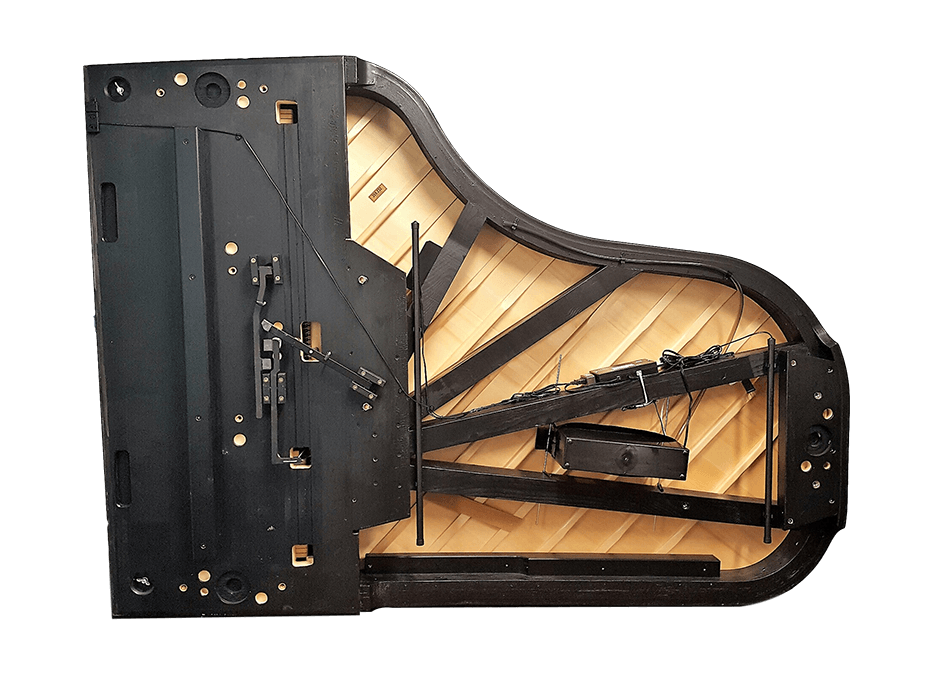
Consider adding a Dampp-Chaser Piano Life Saver System. These will both add humidity to the environment inside your upright or directly under your grand. They also deal with excess humidity in the air, at least in the piano’s microclimate. See more on my Dampp-Chaser guide, as well as information on Dampp-Chaser pricing.
Is the room too hot? Heating the air dries it out, and some people keep their piano room very warm. Raising the air temperature by ten degrees can quite dramatically lower the humidity. If your piano room is currently very warm (above 72 degrees), consider dropping the temperature to help with humidity.
Dehumidifying the Air
Dehumidifiers are appliances dedicated to removing the humidity from the air. These are very effective; however, they tend to slightly increase the air temperature, which sometimes makes the air feel less pleasant to humans.
Air conditioning dehumidifies while it cools, but humidity control depends on run time and correct sizing. Oversized or short cycling systems often leave indoor humidity higher than you’d expect. In persistently damp spaces, a dedicated dehumidifier is usually more reliable. A correctly sized system—not too big and not too small—is better for humidity control than an oversized one.
Heat pumps and ductless mini-split systems are very beneficial for your piano. These devices are quite effective at controlling humidity during the summer. I learned how beneficial these could be after seeing dramatic improvements in clients’ pianos after they installed them.
Is the room too cool? Heating the air dries it out. Sometimes, spaces with low air temperatures, such as basements, will stay relatively humid even through the winter. These spaces are also more prone to condensation. You might consider moving the piano to a warmer environment. I generally recommend sticking around 72 degrees, but the exact temperature isn’t important: Relative humidity is the primary consideration.
You can also consider the dehumidifier-only Dampp-Chaser system. At less than half the cost of a full Piano Life Saver System, these are a very good choice in very humid environments. If you’re seeing mold or signs of high humidity, consider adding one of these systems. See more on my Dampp-Chaser guide, as well as information on Dampp-Chaser pricing.
Control humidity with a Dampp-Chaser
In short: If the room can’t reasonably be controlled, that’s when I look at a Dampp‑Chaser.
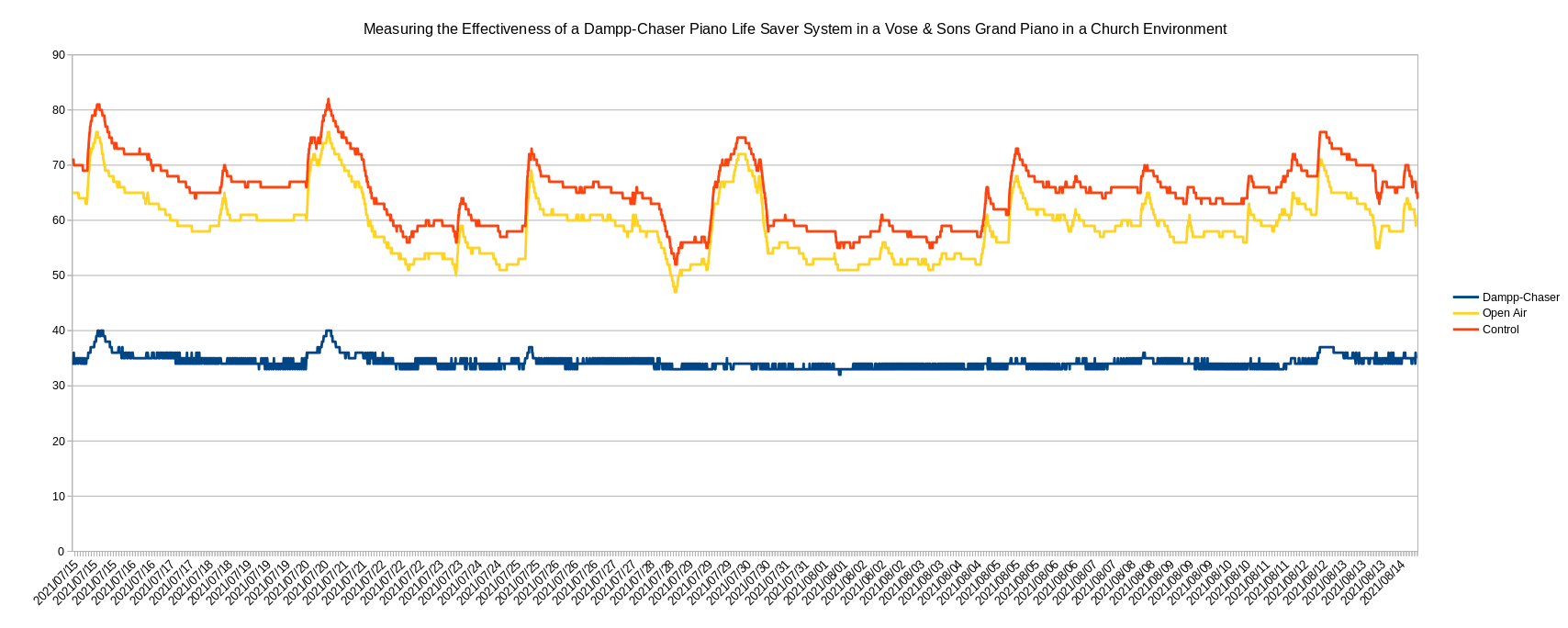
The Dampp-Chaser Piano Life Saver System provides local humidity protection to the piano itself. Some spaces are just difficult. Maybe the piano sits in a big open living room, a drafty old farmhouse, a church that’s only heated on weekends, or a seasonal home that sits empty for months. In those cases, humidifying the room might not be an option. That’s where a Dampp-Chaser Piano Life Saver System comes in.
I have an overview of the system on my Dampp-Chaser FAQ, where I explain what these systems do, what they don’t, and share humidity graphs from installations around Maine.
If you’re weighing whether it’s worth the investment, I break down typical costs by piano type in “What does a Dampp-Chaser cost?” You’ll also find my own current pricing on my general price list.
Owners who already have a system often have the same questions about care and maintenance, so I put together “The 10 most common Dampp-Chaser mistakes” and a separate article on a long-term humidifier water supply for seasonal homes.
If you’re working with a player piano or an instrument with a lot of electronics in the way, there’s a case study on installing a Dampp-Chaser in a Yamaha HQ100 Disklavier upright. This article shows what a backside installation looks like in practice.
Mold and musty odors deserve their own mention: In my piano cleaning guide I talk through what’s realistic to clean yourself, when to consider a dehumidifier-only setup, and how humidity control fits into keeping the interior of the piano safe.
Humidity control brings many benefits
Keeping indoor humidity in a controlled mid‑range isn’t only good for instruments! It can improve indoor air quality and reduce common health triggers.
The EPA recommends 30–50% RH, and the CDC specifically advises keeping humidity under 50% as part of controlling asthma triggers. Mayo Clinic also recommends ≤50% RH to help limit dust mites and mold, which is a concern shared by the American Lung Association. And it turns out that a relative humidity between 40% and 60% is likely an ideal range for dealing with viruses and illness!
In other words, humidity control also helps your piano, your home, and you stay healthier and cleaner!
Manufacturer recommendations
In practice, aiming for 42-45% is an excellent general guideline. However, the “perfect” humidity range for a piano varies somewhat based on the manufacturer.
Most manufacturers explicitly advise that stability is just as critical as the target humidity number. If your humidity swings dramatically each day, that can be very stressful for the piano, regardless of what range it occurs in. This is one reason why having a 24-hour high and low on your hygrometer is so helpful.
Why do ranges vary so much?
Manufacturer “humidity recommendations” often mix three different things: An ideal target (best tuning stability and feel), a safe operating band (avoiding structural/action problems), and a practical customer-facing range. Where manufacturers have multiple recommendations, I’ve done my best to include them below.
Steinway & Sons
Humidity: 45–70% RH, 40-60% RH
Caring for Your Steinway
Service & Maintenance
Yamaha
Humidity: 40–45% RH, 35-55% RH, 45% ideal
Caring for Your Piano
Five Simple Steps for Maintaining your Piano
Kawai
Humidity: 35–70% RH, 45% ideal
Care of Your Kawai Piano (PDF)
C. Bechstein
Humidity: 40–60% RH
Temperature & Humidity
Maintenance and Care
How to care for your piano
Fazioli
Humidity: 30–70% RH
Maintenance
PETROF
Humidity: 30–65% RH
Suitable Environment for the Instrument
Schimmel
Humidity: 40–60% RH
Preserving Value & Care
Citations
Piano Technicians Guild. (n.d.). The PTG recommends humidity control at 42% at 68°F. https://www.ptg.org/teacher-resources/caring-for-a-piano/humidity-control
Steinway & Sons. (n.d.). Caring for your Steinway. https://www.steinwaypianos.com/service/caring-for-your-steinway
Yamaha Canada Music. (n.d.). How to care for your piano. https://ca.yamaha.com/en/products/contents/pianos/how_to_care_for_your_piano/index.html
Yamaha (The Hub). (n.d.). How to take care of your piano. https://hub.yamaha.com/pianos/p-how-to-take-care-of-your-piano/
Kawai. (n.d.). Caring for your Kawai Piano (PDF). https://www.kawai-global.com/mgr/wp-content/uploads/2015/11/Caring-for-your-Kawai-Piano.pdf
C. Bechstein. (n.d.). Maintenance and care: Temperature and humidity. https://www.bechstein.com/en/service/maintenance-and-care/temperature-and-humidity/
ENERGY STAR. (2005). Right-Sized Air Conditioners (Fact sheet PDF). https://www.energystar.gov/ia/home_improvement/home_sealing/RightSized_AirCondFS_2005.pdf
U.S. Department of Energy. (2015). Test Procedures for Dehumidifiers, Final Rule (PDF). https://www.energy.gov/eere/buildings/articles/issuance-2015-06-26-energy-conservation-program-test-procedures
Arundel, A. V., Sterling, E. M., Biggin, J. H., & Sterling, T. D. (1986). Indirect health effects of relative humidity in indoor environments. Environmental Health Perspectives, 65, 351–361. https://pmc.ncbi.nlm.nih.gov/articles/PMC1474709/
AcuRite. (n.d.). Pro Accuracy Indoor Temperature and Humidity Monitor with Alarms (product page). https://www.acurite.com/products/pro-accuracy-indoor-temperature-and-humidity-monitor-with-alarms
AcuRite. (n.d.). Humidity Monitor instructions (PDF hosted by Home Depot). https://images.thdstatic.com/catalog/pdfImages/ca/ca6dabf5-d945-48a4-85c8-9330fb52a7c3.pdf
Boveda. (n.d.). How do I calibrate my hygrometer? https://bovedainc.com/question/how-do-i-calibrate-my-hygrometer-2/
Kai SUN, & Chuan-hui ZHOU. (2015). The Comparison and Analysis of Humidity Environment between Floor and Ceiling Radiant Cooling Systems that Combined with Displacement Ventilation (conference paper PDF). Atlantis Press. https://www.atlantis-press.com/article/25841082.pdf
Ueno, K. (2020). PA-1903: How to Look at a House like a Building Scientist (Part 3: Temperature, Humidity, and HVAC Systems) (web article). Building Science Corporation. https://buildingscience.com/documents/published-articles/pa-1903-how-look-house-building-scientist-part-3-temperature-humidity
Glass, Samuel V., and Samuel L. Zelinka. “Moisture Relations and Physical Properties of Wood.” Wood Handbook: Wood as an Engineering Material, General Technical Report FPL-GTR-190, U.S. Department of Agriculture, Forest Service, Forest Products Laboratory, 2010, pp. 4-1–4-* (Chapter 4), https://www.fpl.fs.usda.gov/documnts/fplgtr/fplgtr190/chapter_04.pdf
Mitchell, Philip H. “Calculating the Equilibrium Moisture Content for Wood Based on Humidity Measurements.” BioResources, vol. 13, no. 1, 2018, pp. 171-175. https://bioresources.cnr.ncsu.edu/resources/calculating-the-equilibrium-moisture-content-for-wood-based-on-humidity-measurements/. Accessed 29 Dec. 2025.