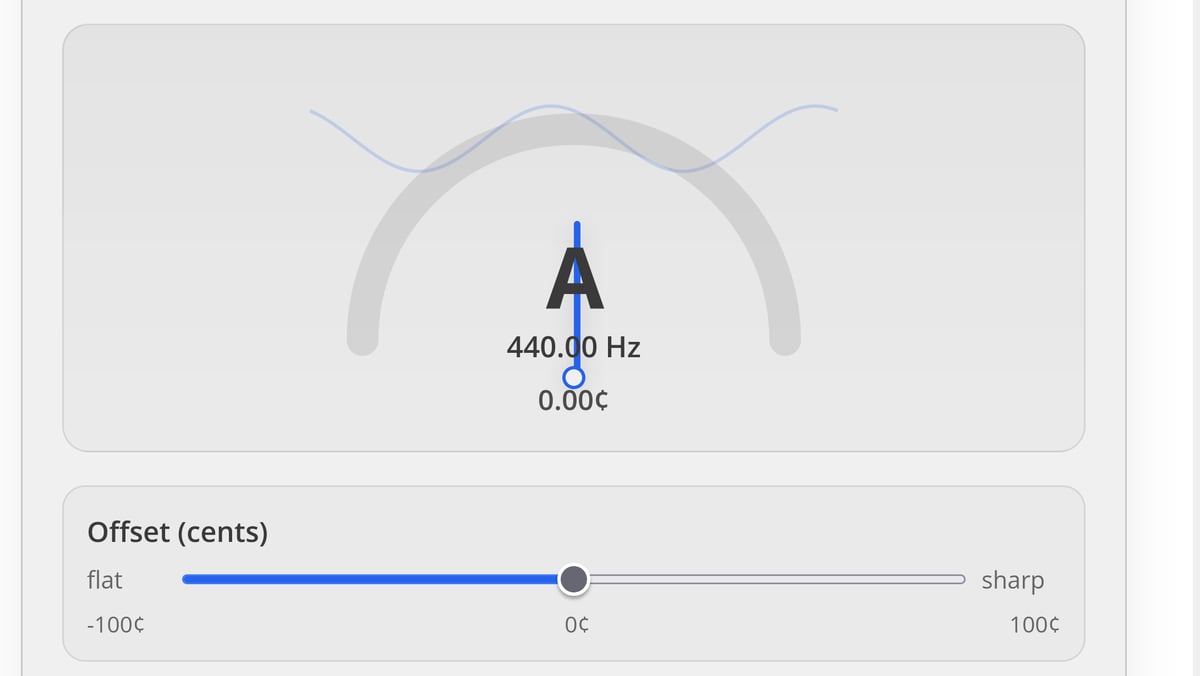
I recently had a customer ask me to tune their piano to A432, and had to quickly calculate how many cents flat relative to A440 to tune. This calculation isn’t especially complicated, but it’s inconvenient to do quickly in the field. I decided to create this simple tool for my own quick and easy reference.
Use this interactive slider to convert cents (¢) to frequency in Hertz (Hz) for A4 (the A above middle C), starting from the standard reference A4 = 440 Hz. A4 = 440 Hz (A440) is the modern concert pitch standard (ISO 16). Slide flat or sharp and watch the frequency update instantly—perfect for unusual tuning requests like A432, and for aligning player-system playback with a tuned acoustic piano.
A4 (440 Hz) Cents Slider
How I use this tool
Customers asking for non-standard tunings (A432, A442, and more)
When someone requests a non-standard pitch like A432, it helps to see exactly what that means in both Hz and cents. This slider makes the conversation simple and transparent.
Yamaha Disklavier ensemble playback pitch (ENSPIRE and similar systems)
If I tune an acoustic piano a little off A440—say 5 cents flat—I can use the tuning / pitch adjustment in the ENSPIRE app (or the appropriate controller/settings) to shift ensemble and accompaniment playback so it matches the piano. ENSPIRE Controller’s Master Tune is adjusted in Hz (0.1 Hz steps), not cents. The app is adjusted by changing the reference A. For instance, if the piano is tuned -7¢, I should set the Disklavier playback to A = 438.2.
What is a cent in music?
A cent is a small unit of pitch. There are 100 cents in a semitone (one piano key) and 1200 cents in an octave. Because cents describe pitch changes consistently, they’re ideal for fine adjustments and for communicating tuning offsets clearly.
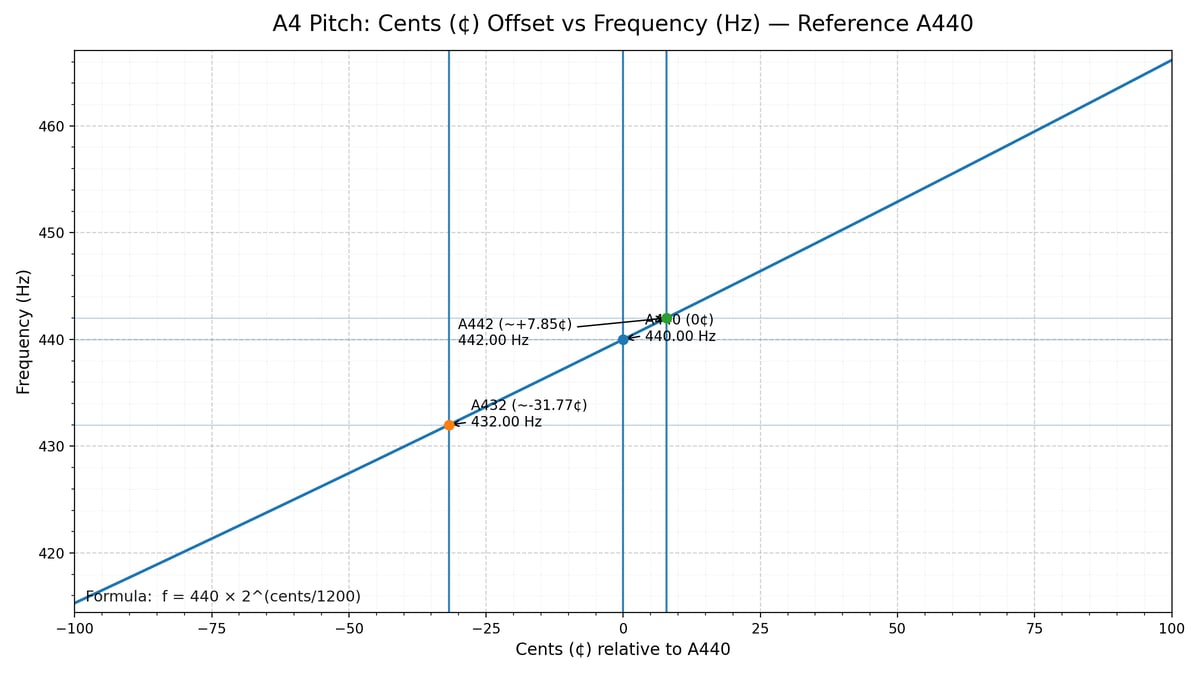
If you’re tuning to A442, then that’s +7.85¢ from A440. In this case, set the AccuTuner (or other electronic tuner) to +7.9¢.
Quick examples you can try
Tuning to A432? That’s about -31.77¢ from A440. If you’re tuning a piano to A432 with a Sanderson Accu-Tuner or similar device, this means you should aim for roughly -31.8¢, matching the precision of the device.
Move the slider to -7¢ and you’ll see A4 drop to about 438.22 Hz. If you’re tuning ensemble Disklavier accompaniment, that means you can adjust the reference A in the app to 438.2 Hz.
A432 → −31.77¢
A440 → 0¢
A442 → +7.85¢
How the cents-to-Hz calculation works
This calculator uses the standard equal-temperament relationship between cents and frequency, assuming f represents frequency and c represents cents:
Or conversely, to convert frequency to cents:
This is a reference for A4. Real piano tuning also involves temperament and stretch across the scale, but A4 is the anchor point people most often want to translate into a precise Hz value.
According to Sanderson’s Accu-Fork manual, a quick field method for conversion is to take the Hz difference from 440 and multiply by 4. In other words, the rule of thumb near A440: 1 Hz ≈ 4 cents (approximate).